
Can AI replace customer service? Not completely. Order status, return policies, store hours: AI handles these questions faster than any team could. Still, when a problem is complicated, emotional or costly, most customers want to talk to a real person. The businesses getting this right use AI for speed and people for trust.
That's the short answer. Below, we look at what AI customer service does well, where it falls short, what customers say in surveys, and how to split the work between bots and people.
What can AI customer service do well?
AI works best on high-volume, low-stakes questions that have one clear answer. It replies in seconds, at any hour, in many languages, and it never gets tired of hearing the same question.
- Order tracking and delivery updates
- Return and refund policy questions
- Store hours, pricing and basic product details
- Sorting and routing tickets before a person steps in
- Drafting replies and summaries for human agents
That last one is easy to overlook. In an NBER field study, an AI assistant helped agents resolve 14% more issues per hour on average, and 34% more for newer agents. AI helps the most when it works alongside a person.
Where does AI fall short in customer service?
AI struggles when a conversation needs empathy, judgment or a real exception to the rules. A damaged parcel, a billing dispute, a cancelled trip, a nervous first-time buyer: each one needs someone who can read the situation, take responsibility and make a call.
Here are the main limitations of AI in customer service:
- AI can sound sure of itself and still be wrong.
- It misses frustration, sarcasm and urgency.
- It can't bend a policy using its own judgment.
- A bad handover forces customers to explain everything twice. In AnswerConnect's survey, 36% called that frustrating and a waste of their time.
Klarna is the case everyone points to. In February 2024 it said its AI assistant was doing the work of 700 agents. By May 2025, its CEO told Bloomberg that AI chatbots were cheaper but gave lower quality, and the company started hiring human agents again.
Do customers prefer AI or human customer service?
Most surveys say people prefer a human, especially when the issue matters. In AnswerConnect's survey of 6,000 adults, 85% would rather speak to a real person than an AI. Okta's research found that 70% of consumers prefer humans, compared with 16% who prefer AI agents.
- A Pegasystems and YouGov survey of more than 4,700 consumers found that only 2% want to deal exclusively with generative AI chatbots, and 46% said AI service rarely or never gets a successful result (CX Dive).
- 57% of people in the AnswerConnect survey trust a business less when AI dominates its support.
- 30% said talking to an AI agent or chatbot is the most frustrating part of contacting a business.
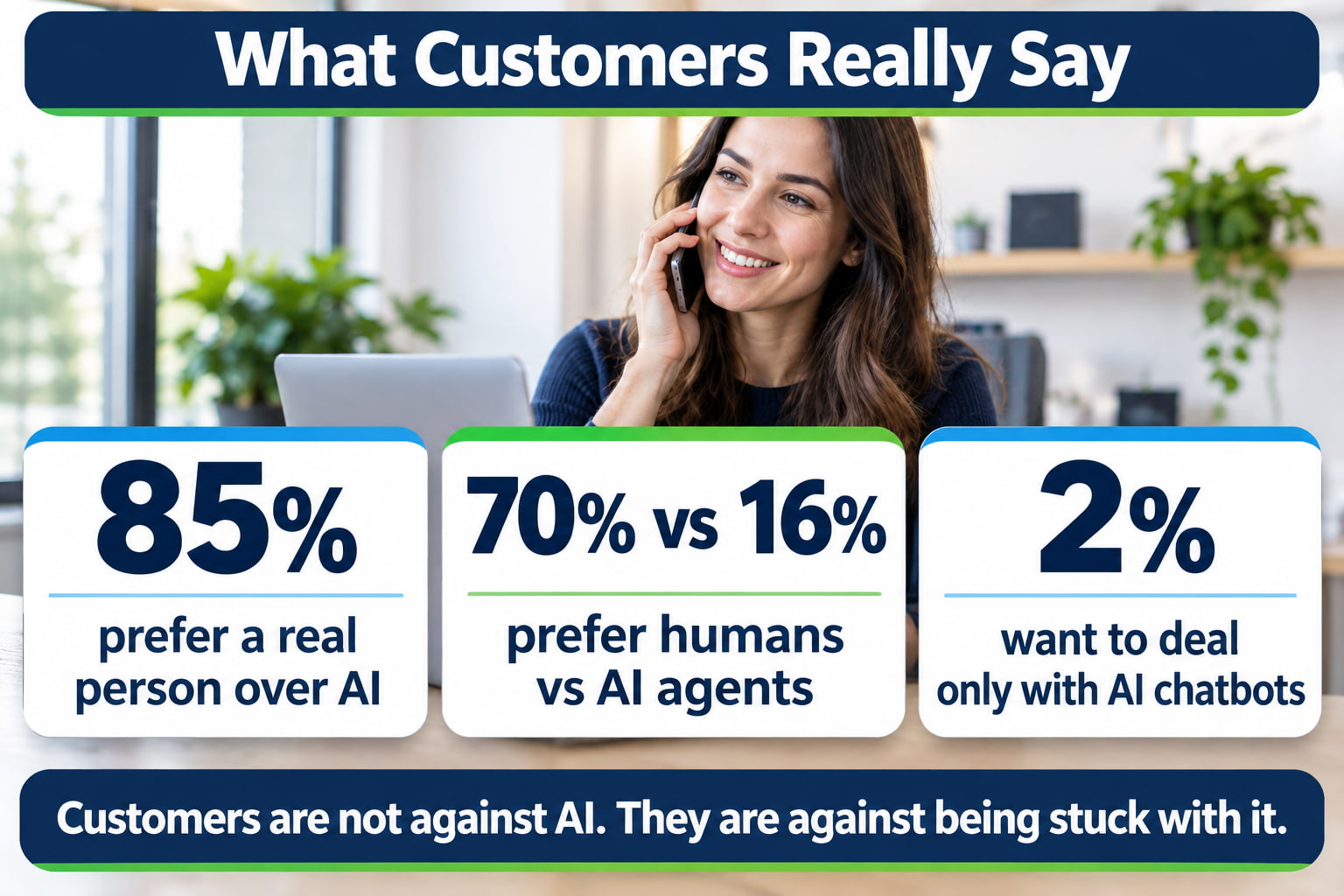
Two fair caveats. AnswerConnect sells human answering services, so keep that in mind when reading its numbers. And people are more open to AI when the question is simple and not urgent, as 8x8's UK survey found. Customers aren't against AI. They're against being stuck with it.
AI vs human customer service: which handles what?
Sort conversations by what's at stake, not by how hard they are to answer. If you're weighing an AI chatbot vs human agent for a given ticket, this table is a good place to start.
| Customer says | Best handled by | Why |
|---|---|---|
| "Where is my order?" | AI | Fast, factual, no judgment needed |
| "What is your return policy?" | AI | The answer already exists in your policy |
| "Which product is right for me?" | AI first, then a person | Buying confidence often needs a real conversation |
| "My order arrived damaged." | Person, with AI support | Needs empathy and a decision on the fix |
| "I want to dispute a charge." | Person | Trust and accountability matter |
| "I want to cancel." | Person | Your last chance to keep the customer |
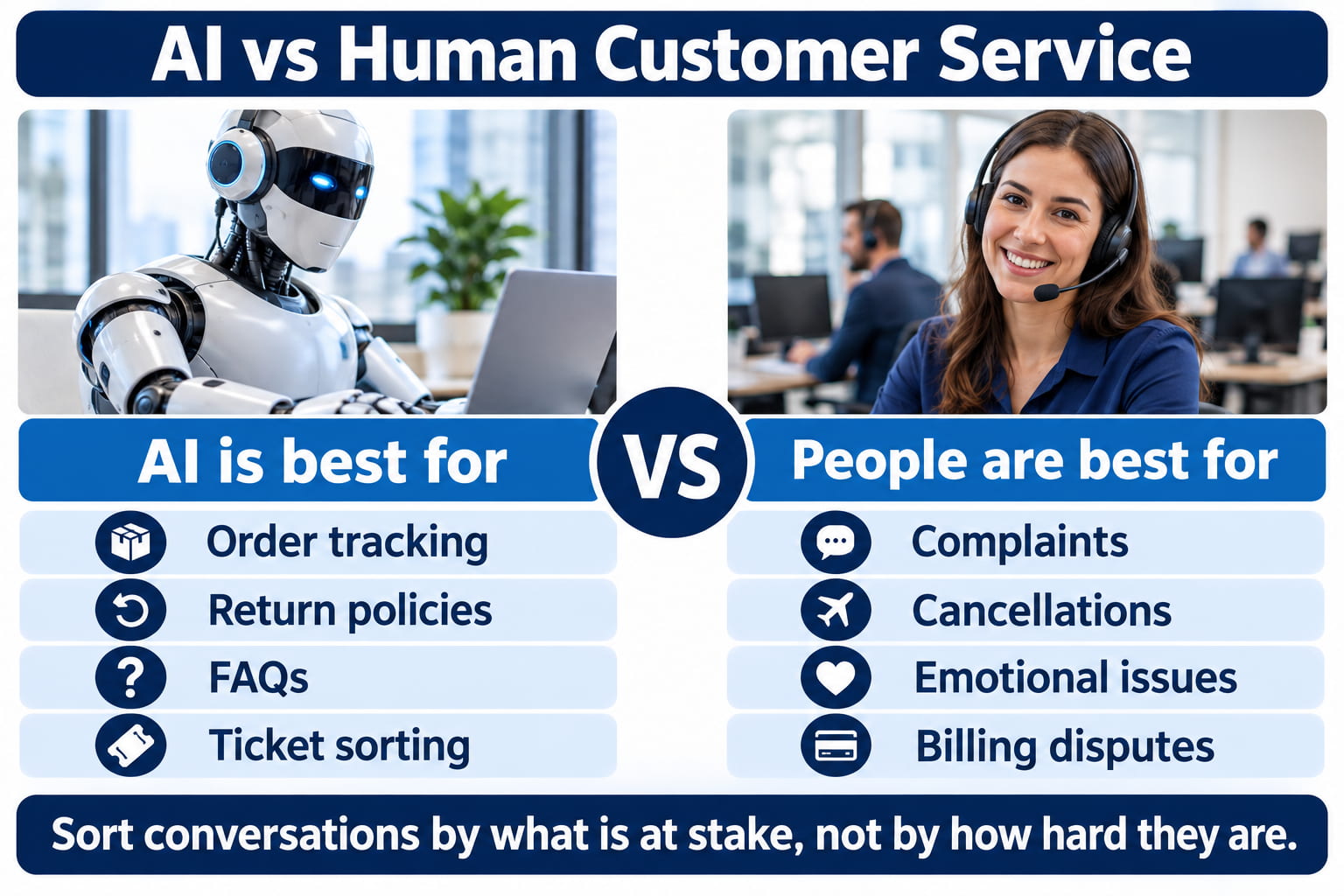
The same pattern shows up outside retail. In travel, chatbots handle booking questions well, but cancellations and missed connections still need an experienced agent. We covered that in Chatbots vs. Human Agents in Travel Support: Which Wins?
Will AI replace customer service jobs?
AI is shrinking routine customer service work, but so far the evidence doesn't point to the job disappearing. The US Bureau of Labor Statistics expects customer service representative jobs to drop by about 5% between 2025 and 2035, yet it still projects around 289,500 openings a year.
A Gartner survey of 321 service leaders found that only 20% had cut agent staffing because of AI, while 55% kept staffing steady and handled more volume. So will AI replace customer service teams? The entry-level, repetitive work is the most at risk. What's left is shifting toward escalations, retention and keeping an eye on the AI itself.
How should businesses combine AI and human customer service?
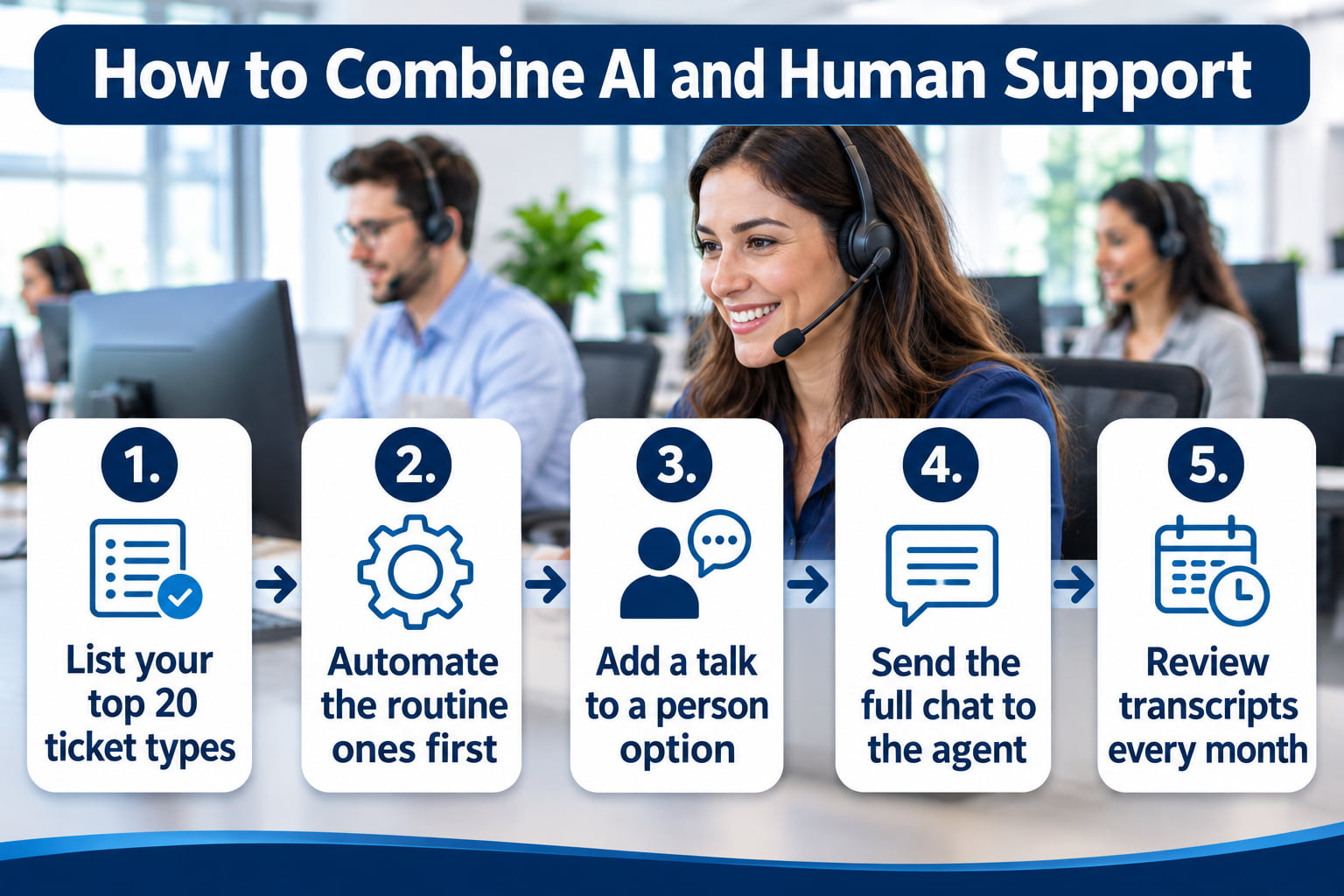
Let AI take the routine questions, and make it easy for customers to reach a person. Here's a simple way to start:
- List your 20 most common ticket types and mark each as routine or high-stakes.
- Automate the routine ones first: order status, returns, FAQs.
- Put a visible "talk to a person" option in every chat.
- When AI hands over, send the full conversation to the agent so the customer doesn't have to repeat themselves.
- Read transcripts every month. Fix the answers AI gets wrong, and track repeat contacts and satisfaction, not only tickets closed.
This is the approach we build customer support around at AAA Outsourcing: AI for speed, trained people for the conversations that decide whether a customer stays.
Learn more about AAA Outsourcing, or see how we support ecommerce customer service and live chat support.
Frequently asked questions
Can AI replace customer service completely?
Not really. AI can take a big chunk of the routine work, like order tracking, FAQs and return policy questions. But it struggles with empathy, exceptions and high-stakes problems. Klarna learned this the hard way: it cut back on human support, saw service quality slip, and ended up hiring agents again.
Will AI replace customer service jobs?
A few of them, yes. The US Bureau of Labor Statistics expects customer service representative jobs to drop by about 5% between 2025 and 2035. The entry-level, repetitive roles are the most at risk. Work that involves escalations, retention and tricky cases will probably become more important.
Is AI better than human customer service?
On simple questions, AI wins on speed, round-the-clock availability and consistency. Humans are better when a situation calls for empathy, judgment or an exception to the rules. Most surveys show customers prefer a person when the issue matters, so a mix usually works best.
What are the limitations of AI in customer service?
AI can sound sure of itself and still be wrong. It also misses emotion and urgency, and it can't bend a rule using its own judgment. Poor handovers make things worse too: 36% of people in one survey called repeating themselves frustrating.
Do customers prefer AI or human customer support?
Most prefer humans. Surveys from AnswerConnect (85%) and Okta (70%) found a clear majority favour a real person. People are more open to AI when the question is simple and not urgent.
Which customer service tasks should you automate?
Start with repetitive, low-risk tasks: order tracking, shipping updates, return policy questions, store information and ticket routing. Keep complaints, exceptions, cancellations and anything emotional with trained people.
How can a small business use AI in customer service?
Start with an AI assistant for your five most common questions, add a visible way to reach a person, and read the transcripts every week. Small teams save the most time on routine replies, which leaves more time for the customers who need a human.
Will AI replace customer support outsourcing?
Unlikely. Outsourcing is changing rather than disappearing: AI takes the routine volume, while trained teams handle complex conversations, escalations and round-the-clock cover.
Conclusion: AI gives speed, people build trust
AI can replace a lot of customer service work. It can't replace the reason customers come back.
AI is the right tool for order tracking, return policies, FAQs and ticket sorting. It's quick, it's always on, and it frees your team from answering the same question all day. But when a customer is upset, confused or about to leave, they want someone who listens, takes ownership and decides what to do. Surveys keep pointing the same way: people accept AI for simple questions and ask for a human when it matters.
So skip the all-or-nothing debate. Ask which conversations to hand to AI and which ones to protect. Start small: automate the routine, keep a clear way to reach a person, and read your transcripts often.
Need trained people for the conversations AI shouldn't handle? Talk to our team.