
A traveler receives a notification that their international flight has been canceled due to severe weather. Their hotel reservation is non-refundable, a connecting flight departs the next morning, and an important business meeting is only hours away. In moments like these, the traveler isn't thinking about whether they're speaking to a chatbot or a customer service representative—they simply want a fast, accurate solution.
This is what makes travel support different from most customer service industries. Every conversation can directly impact someone's journey, budget, or peace of mind. While AI-powered chatbots have transformed how travel businesses handle routine inquiries, human agents continue to play a vital role when situations become more complex or require personalized guidance.
Rather than asking whether chatbots are replacing human agents, travel businesses should ask a more practical question:
Which support interactions benefit from automation, and which are better handled by experienced people?
The answer isn't choosing one over the other. The most successful travel support strategies combine both, using automation to improve speed and efficiency while relying on human expertise for situations that require judgment, flexibility, and problem-solving.
This guide explores where chatbots excel, where human agents create the greatest value, and how travel businesses can build a support experience that works for both customers and operations.
Why Travel Support Isn't Like Other Customer Service
Customer support looks very different depending on the industry.
If an online shopper waits a few hours for a response about returning a pair of shoes, it's usually an inconvenience-not a crisis.
Travel, however, operates on fixed schedules and constantly changing circumstances. Flights depart whether passengers are ready or not. Weather conditions
can disrupt entire routes. Airline policies differ from one carrier to another.
A single delay can affect hotel bookings, airport transfers, connecting flights, cruise departures, and even visa requirements.
That means support teams often have to consider far more than the original question.
For example, a traveler asking to change a flight might also need to know:
- Whether their fare allows changes.
- If the new flight affects a hotel reservation.
- Whether checked baggage will transfer.
- If connecting flights remain valid.
- Whether additional fees apply.
- If alternative routes are available.
What begins as one request can quickly become several interconnected decisions.
This is why travel support isn't simply about answering questions—it's about helping customers navigate situations that often have multiple variables and time-sensitive consequences.
Where Chatbots Deliver the Most Value
Artificial intelligence has become an important part of modern travel support, not because it replaces people, but because it removes friction from routine interactions.
When customers need quick answers rather than personalized advice, chatbots can often provide a faster and more convenient experience.
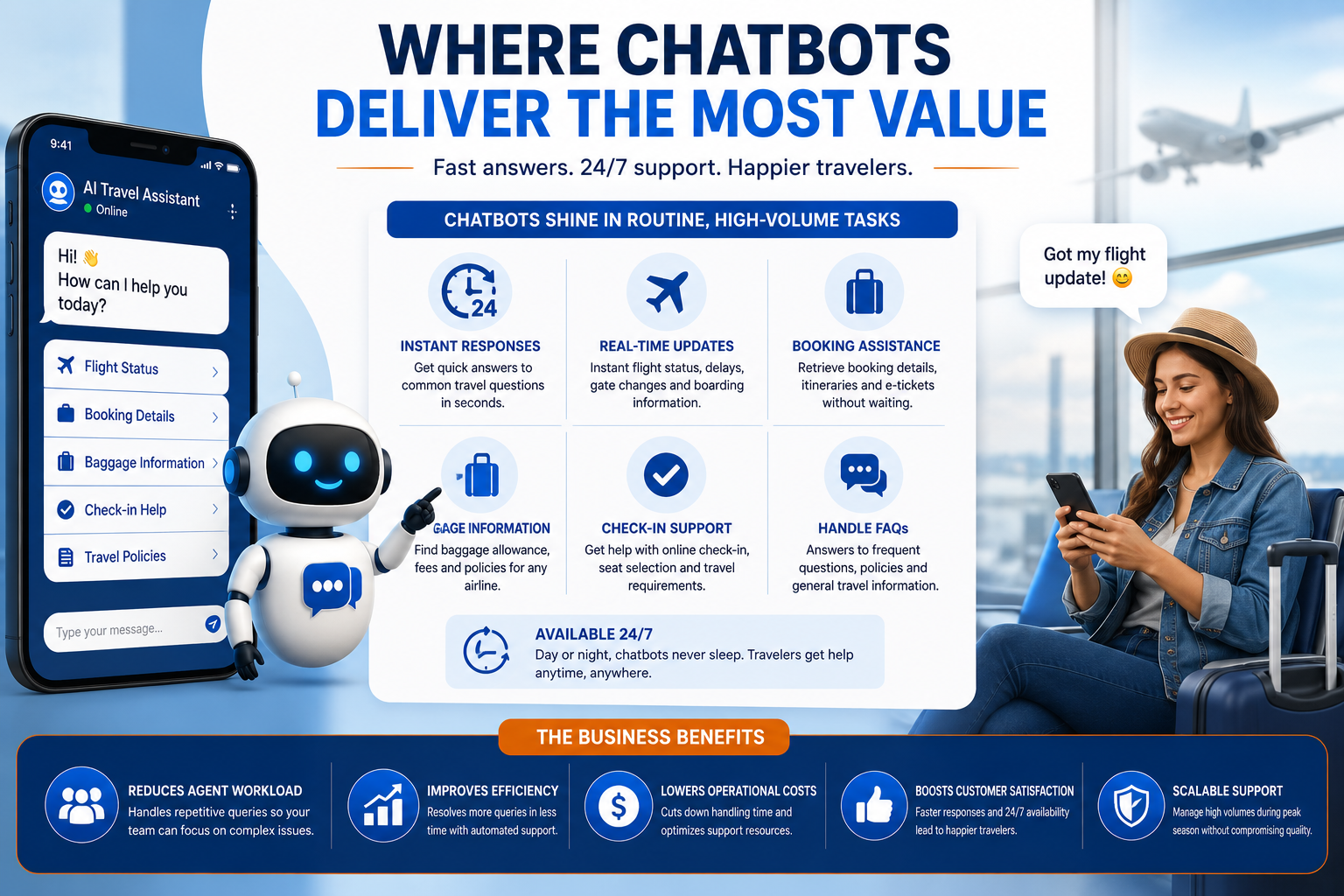
Instant Answers for Everyday Questions
Travel companies receive thousands of repetitive inquiries every day.
Questions such as:
- What is the baggage allowance?
- When does online check-in open?
- How can I download my itinerary?
- What documents are required for domestic travel?
- Can I carry sports equipment?
These requests generally have standardized answers.
Instead of waiting in a phone queue, travelers can receive the information within seconds through a chatbot, allowing support teams to spend more time assisting customers with more complex situations.
Real-Time Travel Updates
One of AI's biggest strengths is delivering live information quickly.
Travelers frequently check:
- Flight status
- Departure delays
- Boarding gates
- Terminal changes
- Boarding times
- Booking confirmations
For someone already on the way to the airport, receiving an instant update is often more valuable than speaking with a representative.
24/7 Availability
Travel doesn't operate during office hours.
Flights depart early in the morning, land after midnight, and cross multiple time zones every day.
A traveler needing baggage information at 2 AM or trying to retrieve a booking confirmation before an early morning departure shouldn't have to wait until the next business day.
Chatbots help fill this gap by providing continuous support for routine requests regardless of location or time zone.
Managing High Volumes During Peak Travel Seasons
Support demand can increase dramatically during:
- Holiday travel
- Weather disruptions
- Airline schedule changes
- Promotional fare sales
- School vacation periods
Instead of requiring every customer to speak with an agent, chatbots can handle repetitive requests such as booking confirmations, flight updates, baggage rules, and travel reminders.
This allows human agents to dedicate more attention to travelers facing urgent or complicated situations.
Collecting Information Before Escalation
Another valuable role for chatbots is preparing conversations before a live agent joins.
Rather than immediately transferring customers, a chatbot can first collect:
- Booking reference
- Passenger name
- Flight number
- Travel dates
- Nature of the issue
For businesses, this improves efficiency. For travelers, it reduces unnecessary repetition.
Where Chatbots Reach Their Limits
Although AI has become increasingly capable, travel rarely follows a perfectly predictable path.
Many conversations begin with a simple question but gradually become more complicated.
Imagine this interaction:
Traveler:
"Can I change my flight?"
The chatbot verifies the booking and displays available options.
Everything appears straightforward.
Then the traveler adds:
"My first flight was delayed, I booked through an online travel agency, I'm traveling with my elderly father, and I need to reach my destination before a cruise departs tomorrow."
Suddenly, the request is no longer just about changing a reservation.
The support team may need to consider airline policies, fare conditions, available routes, accessibility needs, supplier restrictions, and multiple timing options before
recommending the best solution.
Situations like these illustrate an important point:
The value of AI isn't measured by how many conversations it handles. It's measured by how effectively it identifies the conversations that require human expertise.
Where Human Agents Make the Biggest Difference
Just as chatbots have clear strengths, there are situations where experienced human agents provide a level of guidance
that automation alone cannot easily replicate.
Their value isn't simply answering questions-it's helping customers make informed decisions when several options exist.
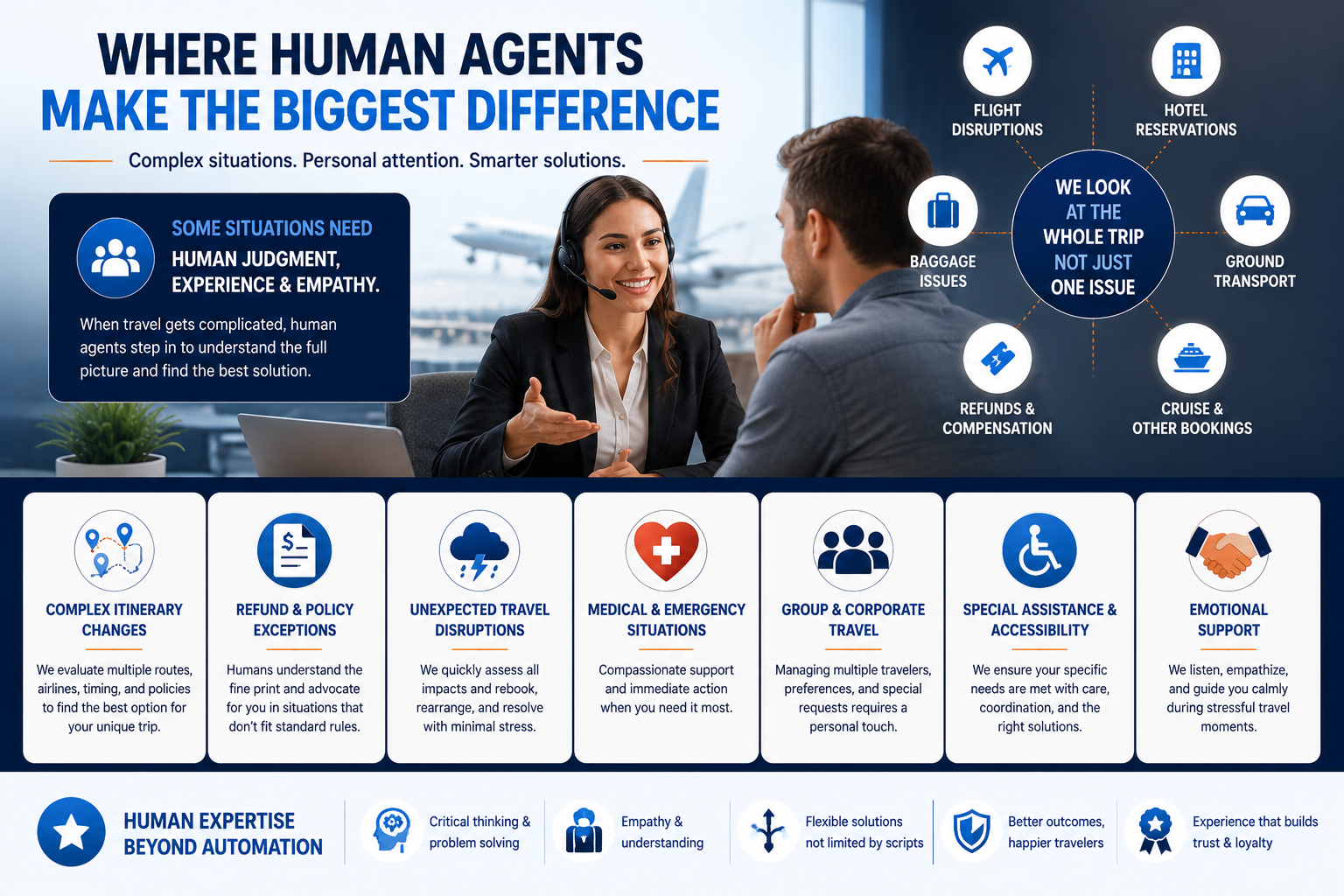
Managing Complex Itinerary Changes
Changing a direct flight is usually straightforward.
Changing a journey involving multiple destinations, partner airlines, stopovers, or separate bookings is considerably more complex.
A traveler may ask:
"Can I leave one day later but still arrive before my conference without canceling my hotel reservation?"
Finding the best answer may involve comparing different routes, checking fare rules, reviewing airline restrictions,
and discussing the advantages and disadvantages of several travel options.
These conversations are often collaborative rather than transactional.
Resolving Travel Disruptions
A canceled flight rarely affects only one booking.
It can also impact:
- Hotel reservations
- Airport transfers
- Cruise departures
- Connecting flights
- Car rentals
- Guided tours
This wider perspective is particularly valuable during weather disruptions or large-scale operational delays.
Helping Customers Navigate Policy Exceptions
Not every situation fits neatly within published travel policies.
Examples include:
- Partially used tickets
- Group bookings
- Corporate travel arrangements
- Accessibility requests
- Medical emergencies
- Complex refund scenarios
Instead of providing a single predefined answer, human agents can evaluate the full picture and guide customers toward the most practical resolution.
In these situations, customers often need someone who can explain available options, clarify limitations, and help them understand how policies apply to their specific circumstances.
Instead of providing a single predefined answer, human agents can evaluate the full picture and guide customers toward the most practical resolution.
The Cost of Choosing the Wrong Support Channel
The debate around AI and human agents often focuses on capabilities-what each can or can't do.
In practice, however, the bigger challenge is assigning the wrong type of request to
the wrong support channel.
For example, asking a human agent to spend several minutes answering a baggage allowance question isn't the best use of their expertise.
Likewise, expecting a chatbot to resolve a complicated refund dispute involving multiple
airlines is likely to frustrate the traveler.
The goal isn't to maximize automation or maximize human involvement. It's to match the
request with the most appropriate support option.
Consider these examples:
| Customer Request | Better Choice | Why It Works |
|---|---|---|
| Flight status update | Chatbot | Real-time information can be delivered instantly. |
| Download booking confirmation | Chatbot | Simple retrieval with no manual review required. |
| Baggage allowance | Chatbot | Standardized information available immediately. |
| Refund dispute | Human Agent | Requires policy interpretation and discussion. |
| Multi-city itinerary | Human Agent | Multiple travel options often need comparison. |
| Flight cancellation | Hybrid | AI shares available options while a human helps finalize complex changes. |
| Lost baggage follow-up | Hybrid | Automation collects details while agents manage ongoing communication. |
A Traveler Doesn't Care Who Helps-They Care That Someone Does
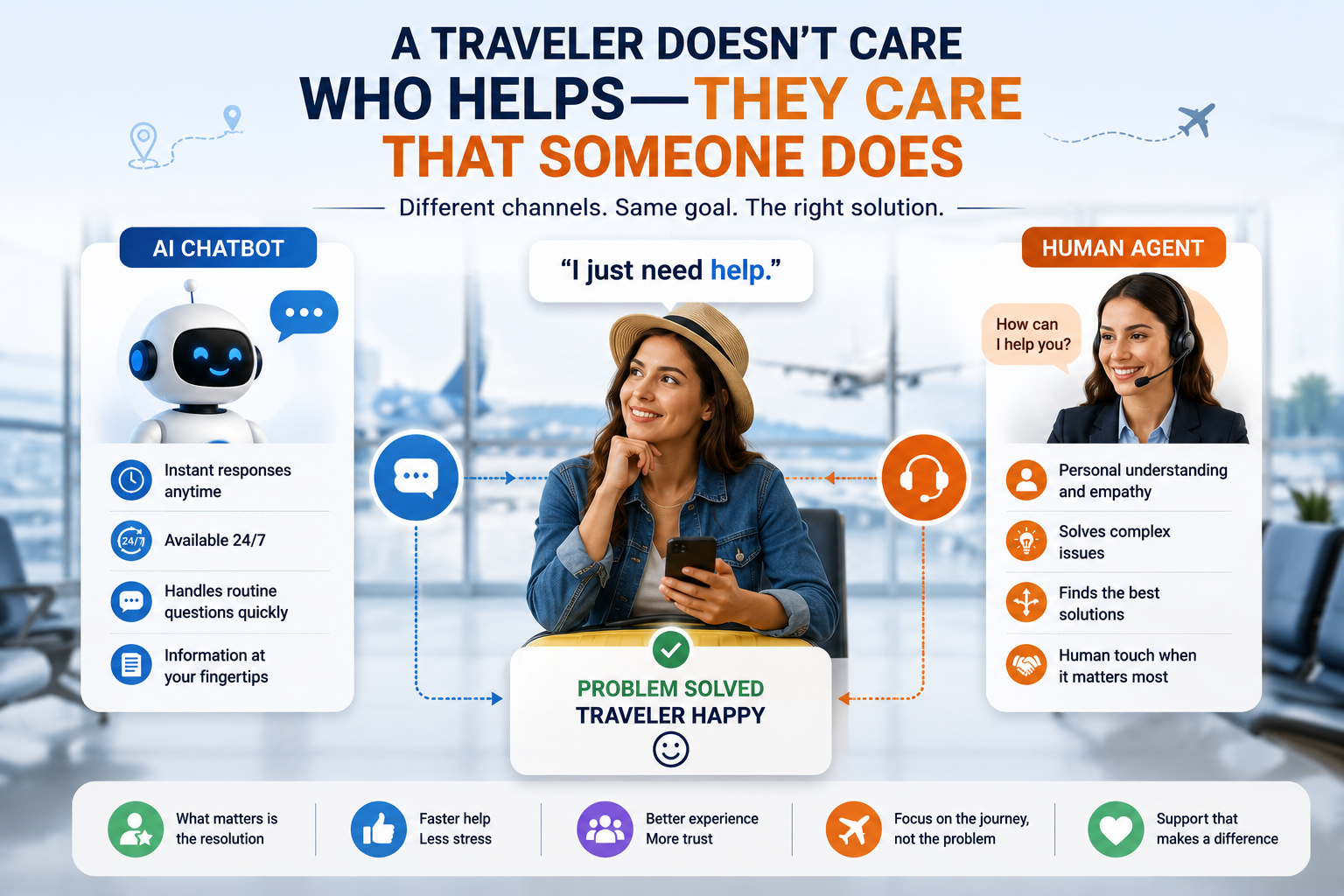
One mistake businesses sometimes make is evaluating support
channels from an internal perspective.
Customers don't.
A traveler rarely thinks:
"I hope I get connected to an AI chatbot."
They also don't necessarily think:
"I only want to speak with a human."
Instead, they're usually asking themselves:
- Can someone solve this quickly?
- Do I need to explain everything again?
- Will I miss my flight?
- Is there another option available?
A chatbot that resolves a simple request within seconds creates a positive experience.
A knowledgeable human agent who calmly helps rebook an international itinerary during a major disruption creates a positive experience.
Both contribute to customer satisfaction when they're used appropriately.
The strongest support strategies don't force customers into one channel. They make it easy to move between automation and human assistance whenever the situation requires it.
Travel Support Decision Matrix
Instead of viewing AI and human agents as competing solutions, travel businesses can think of them as serving different levels of
customer needs.
| Travel Scenario | Chatbot | Human Agent | Hybrid |
|---|---|---|---|
| Flight status | ✅ | ||
| Booking confirmation | ✅ | ||
| Baggage allowance | ✅ | ||
| Check-in assistance | ✅ | ||
| Flight cancellation | ✅ | ||
| Lost baggage | ✅ | ||
| Seat upgrade request | ✅ | ||
| Refund dispute | ✅ | ||
| Multi-city itinerary | ✅ | ||
| Group travel booking | ✅ | ||
| Accessibility request | ✅ | ||
| Corporate travel planning | ✅ |
Rather than replacing one another, each support channel contributes where it provides the greatest value.
The Future Isn't AI vs. Humans-It's Better Collaboration
The future of travel support isn't about proving whether artificial intelligence
is superior to human expertise or vice versa.
Instead, it's about creating smoother collaboration between the two.
As AI continues to improve, chatbots will become more capable of understanding customer intent, retrieving booking information,
and handling routine interactions across multiple communication channels.
At the same time, human agents will increasingly focus on conversations that require critical thinking, negotiation, empathy,
and personalized recommendations.
For travel businesses, success will depend less on adopting the newest technology and more on designing support
journeys where customers can move seamlessly from self-service to live assistance whenever necessary.
Technology should reduce effort.
People should resolve complexity.
Together, they create a more balanced customer experience than either could deliver alone.
Frequently Asked Questions
1. Can chatbots handle all travel support requests?
No. Chatbots are highly effective for routine inquiries such as flight status, booking confirmations, baggage policies, and check-in information. More complex situations—such as itinerary changes, refund disputes, or travel disruptions—often require human judgment and personalized assistance.
2. When should travel businesses involve human agents?
Human agents are most valuable when customer requests involve multiple travel options, policy exceptions, financial decisions, or unique circumstances. Situations like flight cancellations, group bookings, accessibility requests, and complex refunds generally benefit from human support.
3. What is a hybrid travel support model?
A hybrid model combines AI-powered chatbots with human customer service teams. Chatbots manage repetitive tasks and collect basic information, while human agents step in to resolve complex issues. This approach helps businesses improve efficiency without compromising customer experience.
4. What makes a good chatbot-to-human handoff?
An effective handoff ensures that customer information, booking details, and conversation history are automatically shared with the human agent. This prevents travelers from repeating the same information and helps support teams resolve issues more efficiently.
5. How can travel businesses improve customer support without increasing costs?
Many travel businesses improve efficiency by allowing chatbots to manage routine, high-volume inquiries while reserving human expertise for conversations that require judgment or personalized guidance. Regularly reviewing customer feedback, simplifying escalation paths, and reducing unnecessary transfers can also improve the overall support experience.
Conclusion
Chatbots and human agents each have a valuable place in modern travel support.
Chatbots excel at delivering instant answers, automating repetitive tasks, and helping travelers access information whenever they need it. Human agents bring flexibility, experience,
and judgment to situations that involve changing travel plans, resolving disputes, or navigating unexpected disruptions.
The real opportunity isn't choosing one over the other-it's understanding where each performs best.
Travel businesses that combine automation with skilled human support are often better equipped to reduce wait times,
improve operational efficiency, and provide customers with a smoother support experience from beginning to end.
As traveler expectations continue to evolve, the organizations that succeed won't necessarily be those using the
most advanced technology. They'll be the ones that make getting help feel simple, timely, and effortless.
 ✔
✔