Artificial intelligence is no longer a futuristic concept for ecommerce businesses. It answers customer questions in seconds, tracks orders, recommends products, translates conversations, and provides 24/7 assistance without taking a break.
With AI becoming smarter every month, many online store owners are starting to ask the same question:
Can AI replace ecommerce customer service?
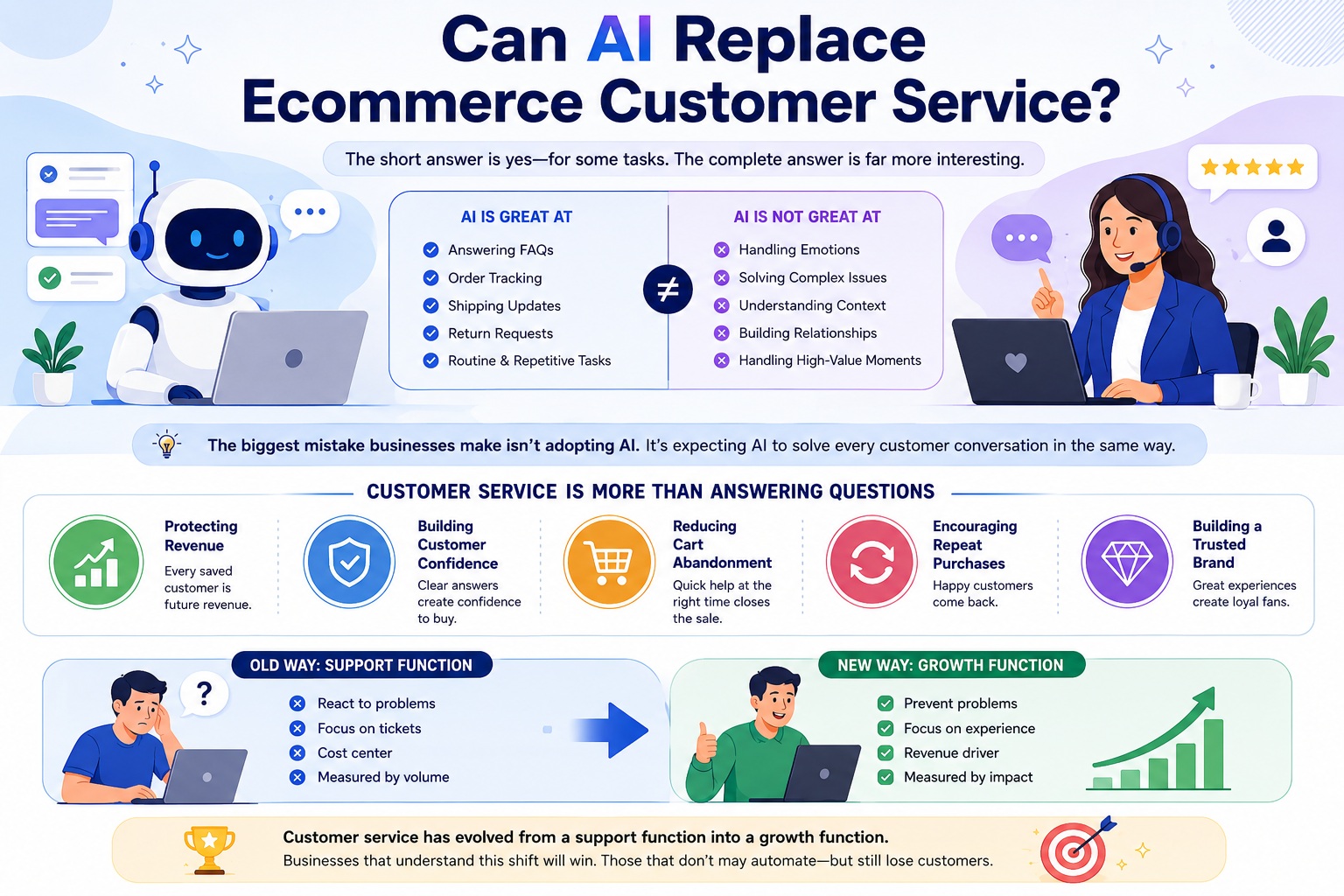
The short answer is yes—for some tasks.
The complete answer is far more interesting.
The biggest mistake businesses make isn't adopting AI. It's expecting AI to solve every customer conversation in exactly the same way.
Because customer service isn't just about answering questions anymore.
It's about protecting revenue, increasing customer confidence, reducing cart abandonment, encouraging repeat purchases, and building a brand customers trust.
In other words, customer service has evolved from a support function into a growth function.
The businesses that understand this shift will gain the most from AI. Those that don't may automate their support while unintentionally creating a poorer customer experience.
Let's look at why.
AI Has Changed Ecommerce Customer Service—And That's a Good Thing
There's no reason to ignore what AI has already achieved.
Modern AI tools can automate a significant portion of routine customer interactions with impressive speed and consistency.
Today, AI can successfully handle tasks like:
- Answering frequently asked questions
- Tracking orders in real time
- Sharing shipping updates
- Explaining return and refund policies
- Providing multilingual customer support
- Directing customers to relevant products
- Offering 24/7 assistance
For ecommerce businesses, that translates into faster response times, lower operational costs, and a better experience for customers who simply need quick answers.
If your support team still spends hours every day answering identical questions, AI isn't replacing valuable work—it's removing repetitive work.
That's exactly what automation should do.
The real opportunity isn't replacing people.
It's allowing people to spend more time on conversations that actually influence business outcomes.
The Wrong Question Every Ecommerce Business Is Asking
Most discussions about AI begin with a simple question:
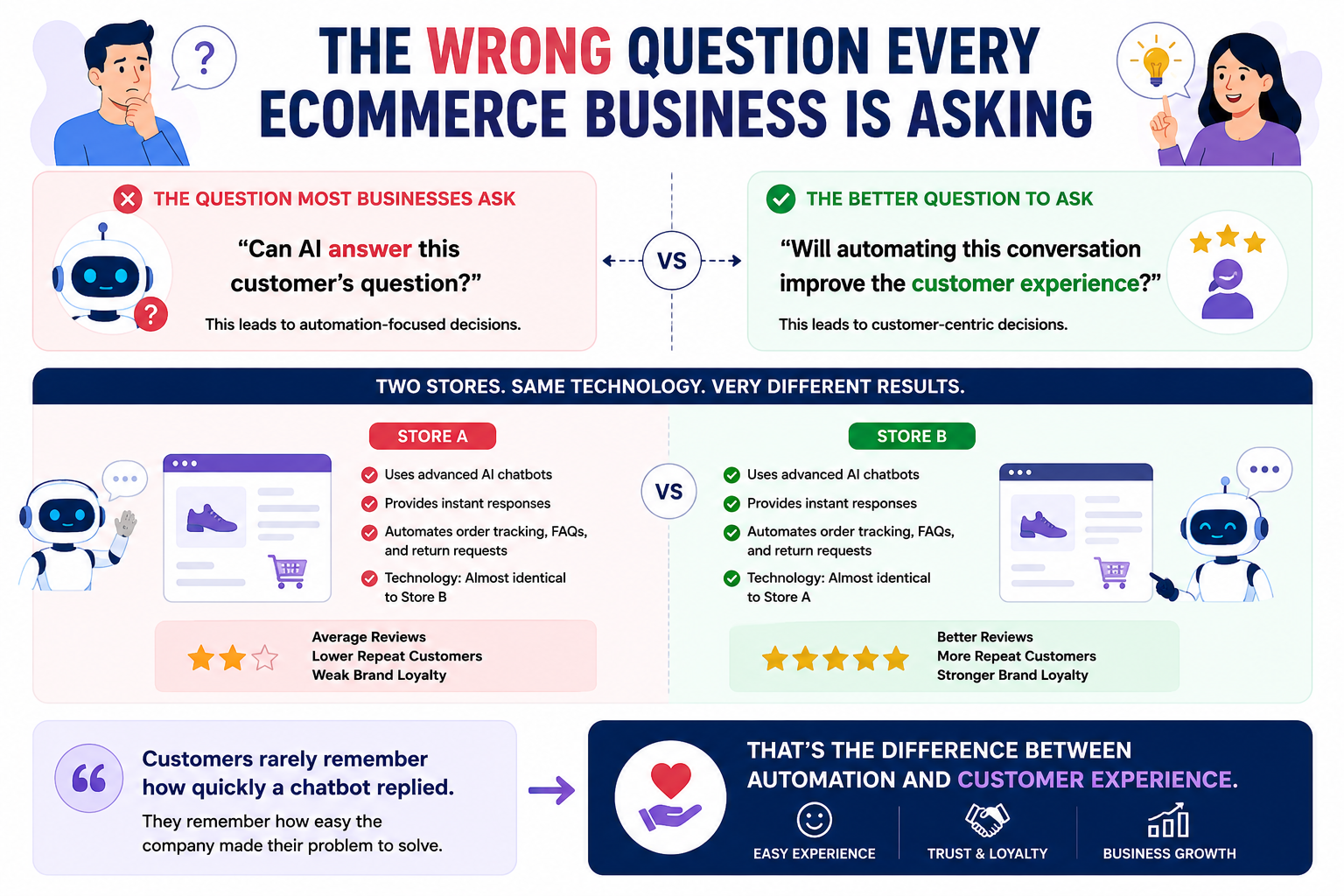
“Can AI answer this customer's question?”
But that's not the question business owners should be asking.
A much better question is:
“Will automating this conversation improve the customer experience?”
Those two questions lead to completely different decisions.
Imagine two online stores selling similar products.
Both use advanced AI chatbots.
Both provide instant responses.
Both automate order tracking, FAQs, and return requests.
From a technology standpoint, they're almost identical.
Yet one store consistently earns better reviews, more repeat customers, and stronger brand loyalty.
Why?
Because customers rarely remember how quickly a chatbot replied.
They remember how easy the company made their problem to solve.
That's the difference between automation and customer experience.
Every Customer Conversation Doesn't Have the Same Business Value
One of the biggest misconceptions in ecommerce customer service is treating every support request as equally important.
In reality, different conversations have very different impacts on your business.
| Customer Conversation | Primary Goal | Business Value | AI's Role |
|---|---|---|---|
| “Where is my order?” | Information | Low | Excellent |
| “What are your return policies?” | Information | Low | Excellent |
| “Which product is right for me?” | Buying confidence | High | Helpful, but may need human guidance |
| “My package arrived damaged.” | Problem resolution | High | Supports the process, but often benefits from human ownership |
| “I'm thinking about cancelling my subscription.” | Customer retention | Very High | Can assist, but requires thoughtful handling |
Notice something interesting.
The complexity of a conversation doesn't always determine its importance.
Sometimes a single customer asking whether they should cancel their subscription is far more valuable than answering hundreds of order-tracking questions.
That's why successful ecommerce businesses don't measure customer service only by the number of tickets resolved.
They measure it by the business outcomes those conversations influence.
AI Is Becoming the Standard—Not the Competitive Advantage
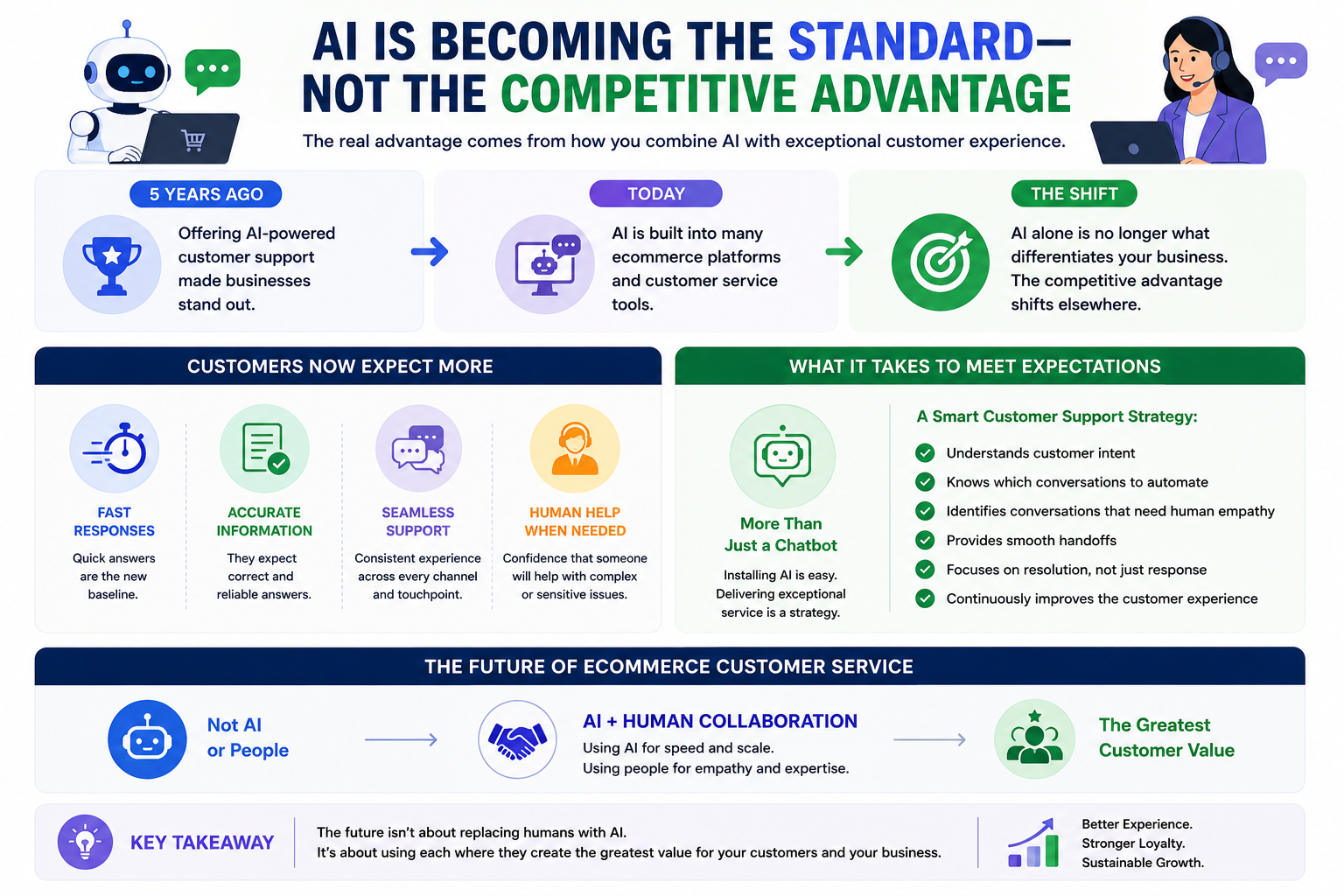
Five years ago, offering AI-powered customer support made businesses stand out.
Today, AI is built into many ecommerce platforms and customer service tools.
That changes the conversation.
If your competitors can access similar AI technology, then AI alone is no longer what differentiates your business.
The competitive advantage shifts elsewhere.
It shifts to how effectively your business combines automation with customer experience.
Customers now expect fast responses.
They also expect accurate information, seamless support, and confidence that someone will help if their situation becomes more complicated.
Meeting those expectations requires more than simply installing a chatbot.
It requires a customer support strategy that understands which conversations should be automated and which ones deserve greater attention.
That's where the future of ecommerce customer service is heading—not toward choosing between AI and people, but toward using each where they create the greatest value.
Reality Check for Ecommerce Businesses
Before asking whether AI can replace customer service, ask yourself these questions:
- Are most of your support requests repetitive, or do they require judgment?
- How many customers contact you before making a purchase?
- Which conversations directly influence repeat purchases or customer loyalty?
- If every support interaction became automated tomorrow, would your customer experience improve—or simply become faster?
The answers reveal something important.
AI isn't changing whether businesses need customer support.
It's changing what great customer support should look like.
The Future Isn't AI vs. Human Support—It's About Smarter Customer Service
One of the biggest misconceptions surrounding AI is that businesses eventually have to choose between automation and human support.
In reality, the most successful ecommerce brands are doing the opposite.
They're using AI to remove repetitive work so their customer support teams can focus on conversations that create business value.
Think about it this way.
If AI saves your team three hours every day by handling order tracking and FAQs, those three hours don't disappear.
They can now be spent helping first-time buyers make confident purchasing decisions, resolving complex issues faster, following up with unhappy customers, or improving the overall customer experience.
That's where customer service starts contributing to business growth rather than simply answering support tickets.
AI Is Changing What Businesses Should Expect From Customer Support
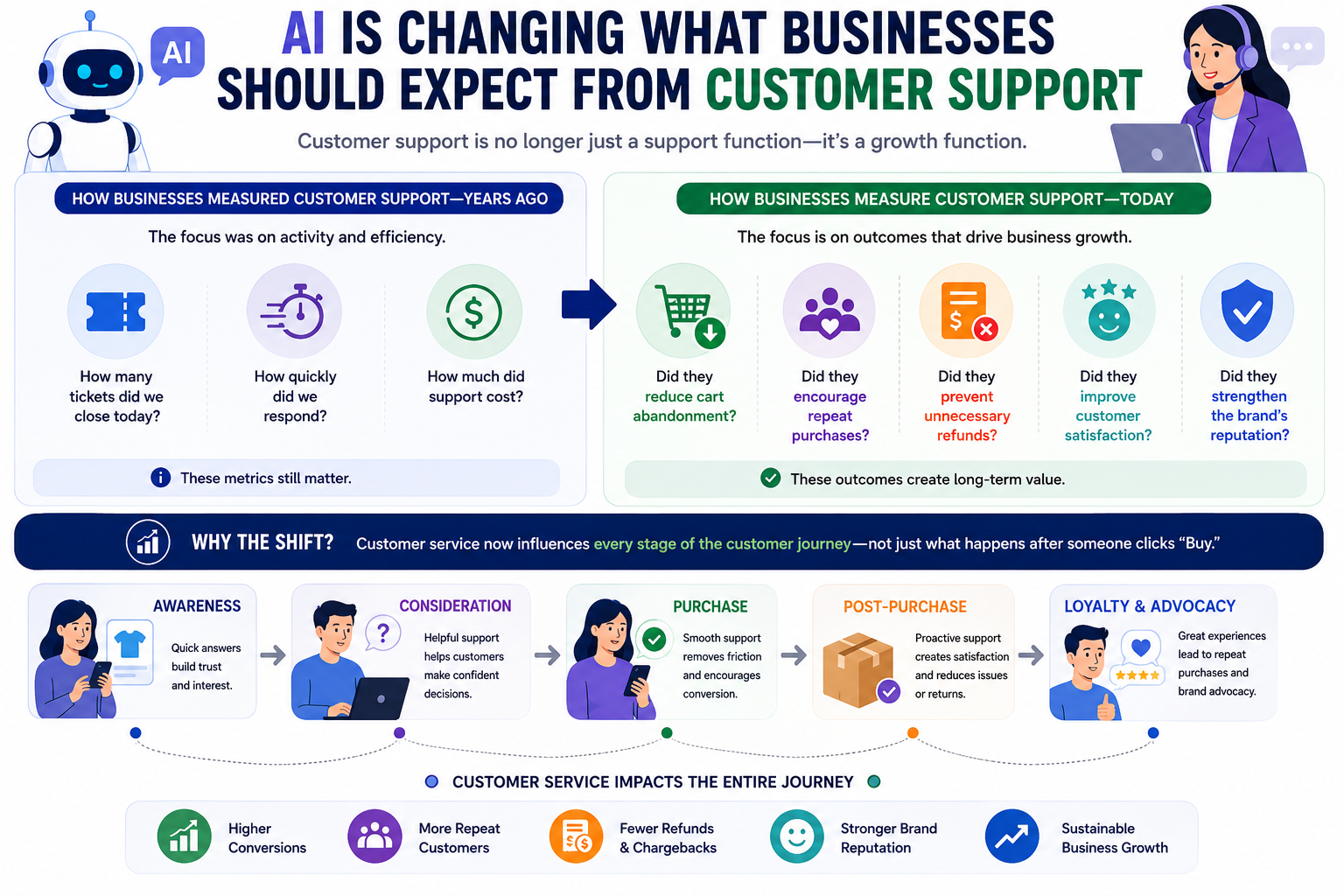
Years ago, businesses measured customer service by asking:
- How many tickets did we close today?
- How quickly did we respond?
- How much did support cost?
Those metrics still matter.
But ecommerce has changed.
Today's customer support teams are increasingly measured by different outcomes.
For example:
- Did they reduce cart abandonment?
- Did they encourage repeat purchases?
- Did they prevent unnecessary refunds?
- Did they improve customer satisfaction?
- Did they strengthen the brand's reputation?
That's because customer service now influences every stage of the customer journey—not just what happens after someone clicks “Buy.”
The Most Expensive Customer Isn't the One Who Complains
Here's something many businesses don't realize.
The customer who sends multiple complaints isn't necessarily your biggest risk.
The biggest risk is often the customer who quietly leaves without saying anything.
Imagine spending money on SEO, paid advertising, social media campaigns, and email marketing to bring someone to your online store.
They browse your products.
They ask one important question through live chat.
They don't receive the clarity they were looking for.
Instead of complaining…
They simply leave.
You never know why.
That isn't just a customer service problem.
It's a lost marketing investment.
Great customer support doesn't only solve problems.
Sometimes it prevents problems before they happen.
AI Doesn't Replace Customer Relationships
Technology is becoming faster every year.
Customer expectations are growing just as quickly.
People now expect businesses to provide:
- Instant replies
- Accurate information
- Multiple support channels
- Self-service options
- Faster resolutions
AI helps businesses deliver all of these efficiently.
But relationships are built differently.
Customers remember businesses that:
- Took ownership when something went wrong.
- Helped them make the right buying decision.
- Resolved a complicated issue without unnecessary delays.
- Made them feel valued instead of treated like another support ticket.
Those moments create loyalty.
Loyal customers buy more, recommend brands to others, and cost significantly less to retain than acquiring new customers.
That's why customer experience remains one of the strongest competitive advantages in ecommerce.
What Smart Ecommerce Businesses Are Doing Today
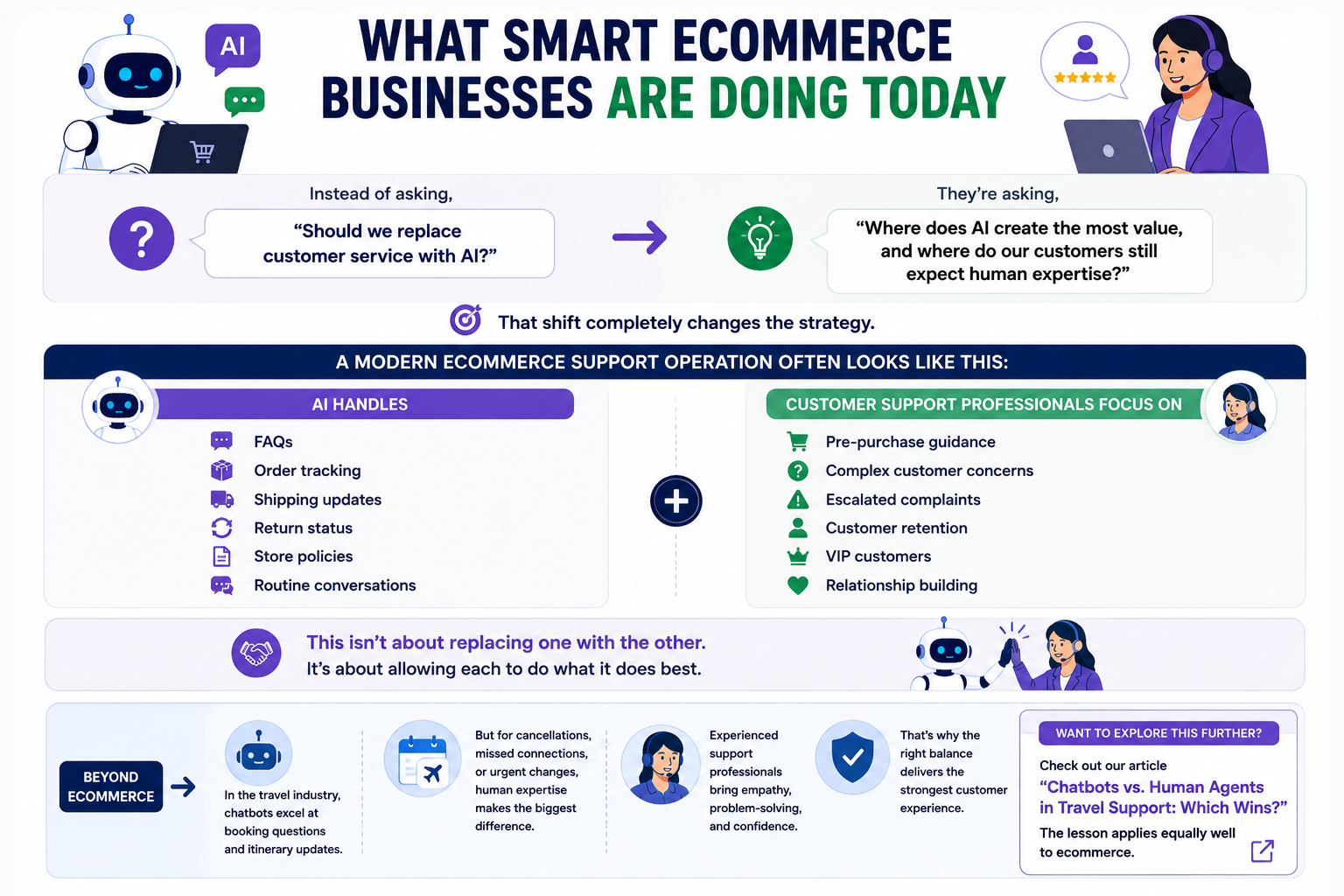
Instead of asking,
“Should we replace customer service with AI?”
They're asking,
“Where does AI create the most value, and where do our customers still expect human expertise?”
That shift completely changes the strategy.
A modern ecommerce support operation often looks like this:
| AI Handles | Customer Support Professionals Focus On |
|---|---|
| FAQs | Pre-purchase guidance |
| Order tracking | Complex customer concerns |
| Shipping updates | Escalated complaints |
| Return status | Customer retention |
| Store policies | VIP customers |
| Routine conversations | Relationship building |
This isn't about replacing one with the other.
It's about allowing each to do what it does best.
Interestingly, we see the same pattern beyond ecommerce. In the travel industry, for example, chatbots have become excellent at answering booking questions and itinerary updates. However, when travelers deal with cancellations, missed connections, or urgent changes, experienced support professionals still make the biggest difference. That's one reason we explored this balance further in our article, Chatbots vs. Human Agents in Travel Support: Which Wins? The lesson applies equally well to ecommerce.
So, Can AI Replace Ecommerce Customer Service?
AI will continue becoming faster, smarter, and more capable.
There's no doubt about that.
Businesses that ignore AI will likely struggle to meet modern customer expectations.
But expecting AI to replace every customer interaction is a different conversation.
Customer service has evolved.
It's no longer just about answering questions.
It's about protecting customer trust, supporting buying decisions, encouraging loyalty, and creating experiences that customers remember long after the transaction is complete.
AI can accelerate those goals.
It cannot achieve all of them alone.
Frequently Asked Questions
Can AI replace ecommerce customer service?
AI can automate routine tasks like FAQs, order tracking, and shipping updates. However, complex issues, buying decisions, and customer relationship management still benefit from human expertise.
What customer service tasks can AI handle?
AI is ideal for answering FAQs, tracking orders, processing basic returns, sharing product information, and providing 24/7 support. These repetitive tasks save time and improve efficiency.
Where does AI struggle in customer service?
AI may struggle with complex complaints, unique customer situations, purchase guidance, and conversations that require empathy, flexibility, or critical decision-making.
Is AI better than human customer support?
Not necessarily. AI delivers speed and consistency, while human support provides judgment, personalized assistance, and stronger customer relationships. The best results come from using both together.
Can AI improve customer satisfaction?
Yes. AI improves response times and availability. However, customer satisfaction also depends on how effectively businesses resolve complex issues and build customer trust.
Should small ecommerce businesses use AI?
Absolutely. AI helps small businesses automate repetitive support tasks and provide faster responses while keeping operational costs under control.
Will AI replace customer support outsourcing?
AI is changing how customer support is delivered, not replacing it. Many businesses use AI for routine tasks while relying on experienced support teams for complex customer interactions.
8. What is the best customer support strategy for ecommerce businesses?
The most effective strategy is to automate repetitive tasks with AI while allowing experienced support professionals to handle high-value conversations that impact customer satisfaction and loyalty.
Final Thoughts
The future of ecommerce customer service isn't about choosing between AI and people.
It's about understanding where each creates the greatest business value.
Businesses that embrace AI for repetitive tasks will become more efficient.
Businesses that combine AI with experienced customer support professionals will be better positioned to build stronger customer relationships, improve retention, and create long-term growth.
At AAA Outsourcing, we don't see AI as a replacement for customer support—we see it as a powerful tool that helps support teams perform at a higher level. By combining intelligent automation with experienced customer service professionals, ecommerce businesses can deliver faster responses, solve more meaningful customer problems, and create experiences that competitors relying on automation alone often struggle to match.
 ✔
✔