
Most ecommerce businesses review customer support conversations to answer one question:
“Did we resolve the customer's issue?”
We approached them differently.
Instead of focusing on response times or ticket resolution, we looked for patterns that reveal how customers think, where businesses unintentionally create friction, and which conversations quietly influence revenue, retention, and brand trust.
Before we continue, an important note: this isn't a scientific research paper or a study backed by independently verified data. It's a practical analysis based on recurring ecommerce support scenarios, operational observations, and the kinds of customer conversations support teams handle every day.
What surprised us wasn't the number of shipping questions or return requests.
It was this:
Most support tickets weren't actually support problems.
They were symptoms of problems somewhere else in the business.
Once you start viewing support conversations as business intelligence instead of operational tasks, they become one of the most valuable sources of insight in your ecommerce operation.
The First Mistake: Looking at Tickets Instead of Triggers
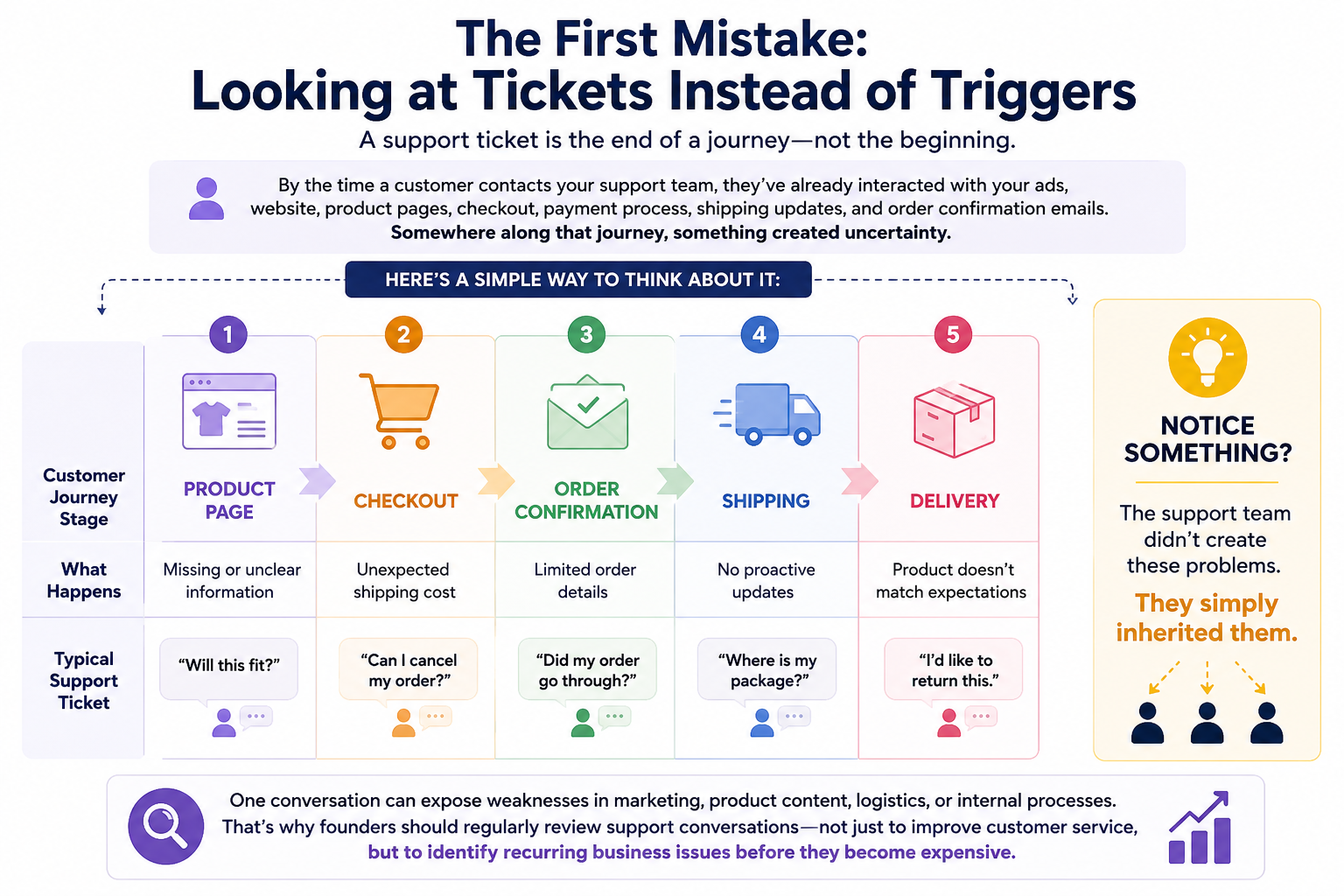
A support ticket is the end of a journey—not the beginning.
By the time a customer contacts your support team, they've already interacted with your ads, website, product pages, checkout, payment process, shipping updates, and order confirmation emails.
Somewhere along that journey, something created uncertainty.
Here's a simple way to think about it:
| Customer Journey Stage | What Happens | Typical Support Ticket |
|---|---|---|
| Product Page | Missing or unclear information | “Will this fit?” |
| Checkout | Unexpected shipping cost | “Can I cancel my order?” |
| Order Confirmation | Limited order details | “Did my order go through?” |
| Shipping | No proactive updates | “Where is my package?” |
| Delivery | Product doesn't match expectations | “I'd like to return this.” |
Notice something?
The support team didn't create these problems.
They simply inherited them.
One conversation can expose weaknesses in marketing, product content, logistics, or internal processes. That's why founders should regularly review support conversations—not just to improve customer service, but to identify recurring business issues before they become expensive.
Lesson #1: Every Customer Asks Two Questions
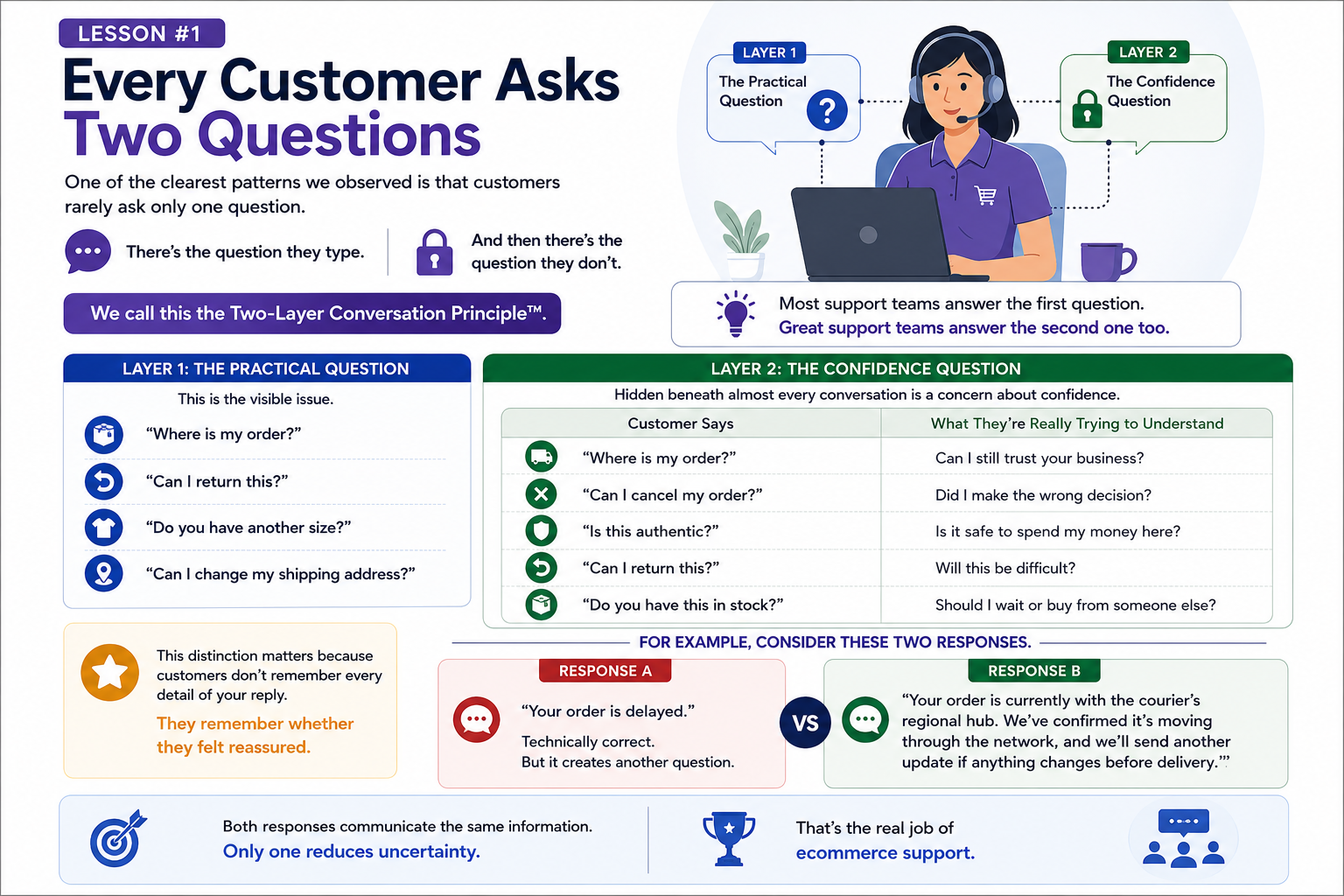
One of the clearest patterns we observed is that customers rarely ask only one question.
There's the question they type.
And then there's the question they don't.
We call this the Two-Layer Conversation Principle™.
Layer 1: The Practical Question
This is the visible issue.
- “Where is my order?”
- “Can I return this?”
- “Do you have another size?”
- “Can I change my shipping address?”
Most support teams answer this question.
Great support teams answer the second one too.
Layer 2: The Confidence Question
Hidden beneath almost every conversation is a concern about confidence.
| Customer Says | What They're Really Trying to Understand |
|---|---|
| Where is my order? | Can I still trust your business? |
| Can I cancel my order? | Did I make the wrong decision? |
| Is this authentic? | Is it safe to spend my money here? |
| Can I return this? | Will this be difficult? |
| Do you have this in stock? | Should I wait or buy from someone else? |
This distinction matters because customers don't remember every detail of your reply.
They remember whether they felt reassured.
For example, consider these two responses.
Response A
“Your order is delayed.”
Technically correct.
But it creates another question.
Response B
“Your order is currently with the courier's regional hub. We've confirmed it's moving through the network, and we'll send another update if anything changes before delivery.”
Both responses communicate the same information.
Only one reduces uncertainty.
That's the real job of ecommerce support.
Lesson #2: The Most Valuable Conversations Aren't Always the Loudest
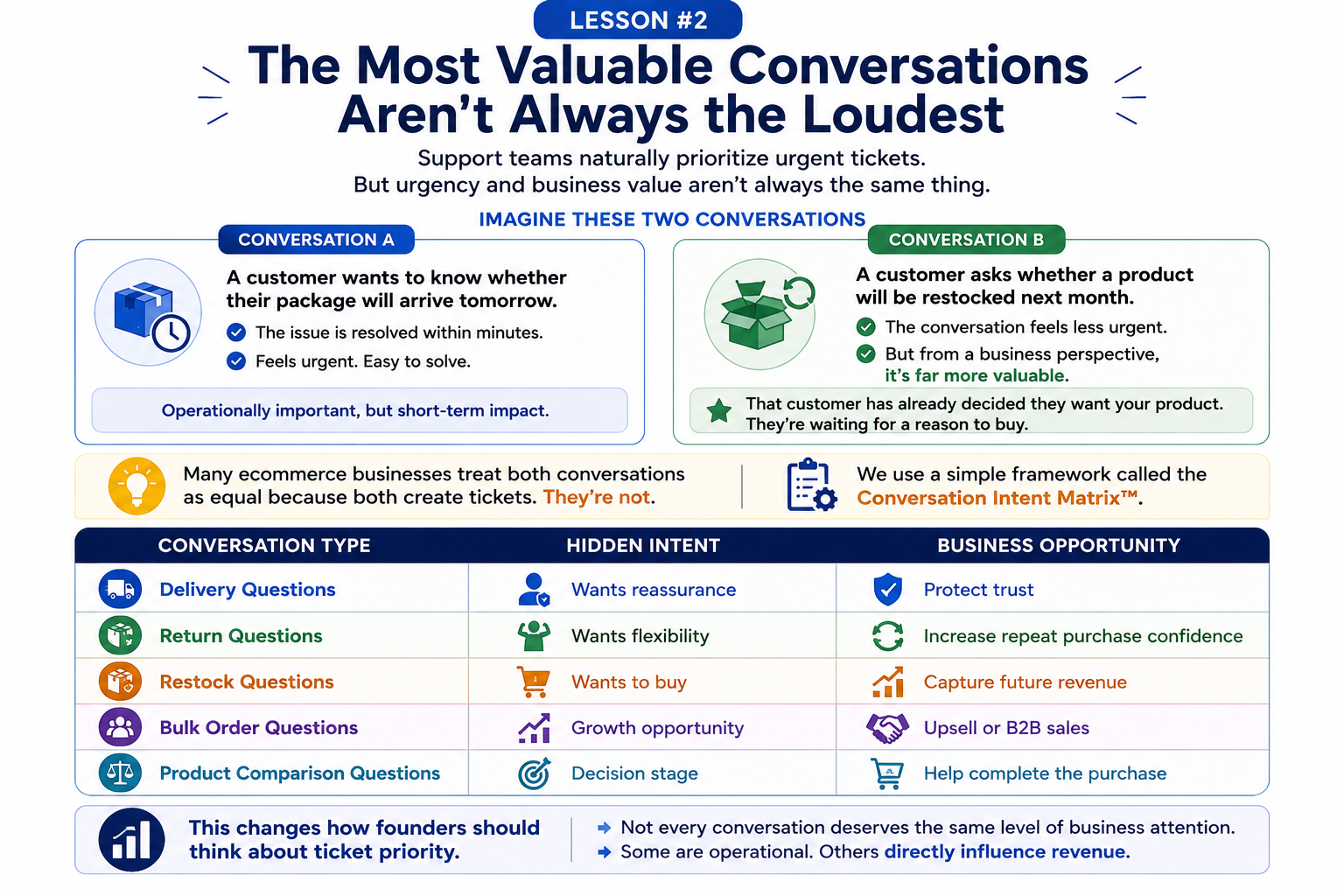
Support teams naturally prioritize urgent tickets.
But urgency and business value aren't always the same thing.
Imagine these two conversations.
Conversation A
A customer wants to know whether their package will arrive tomorrow.
The issue is resolved within minutes.
Conversation B
A customer asks whether a product will be restocked next month.
The conversation feels less urgent.
But from a business perspective, it's far more valuable.
That customer has already decided they want your product.
They're waiting for a reason to buy.
Many ecommerce businesses treat both conversations as equal because both create tickets.
They're not.
We use a simple framework called the Conversation Intent Matrix™.
| Conversation Type | Hidden Intent | Business Opportunity |
|---|---|---|
| Delivery Questions | Wants reassurance | Protect trust |
| Return Questions | Wants flexibility | Increase repeat purchase confidence |
| Restock Questions | Wants to buy | Capture future revenue |
| Bulk Order Questions | Growth opportunity | Upsell or B2B sales |
| Product Comparison Questions | Decision stage | Help complete the purchase |
This changes how founders should think about ticket priority.
Not every conversation deserves the same level of business attention.
Some are operational.
Others directly influence revenue.
Lesson #3: We Found Four Business Problems Behind Almost Every Ticket
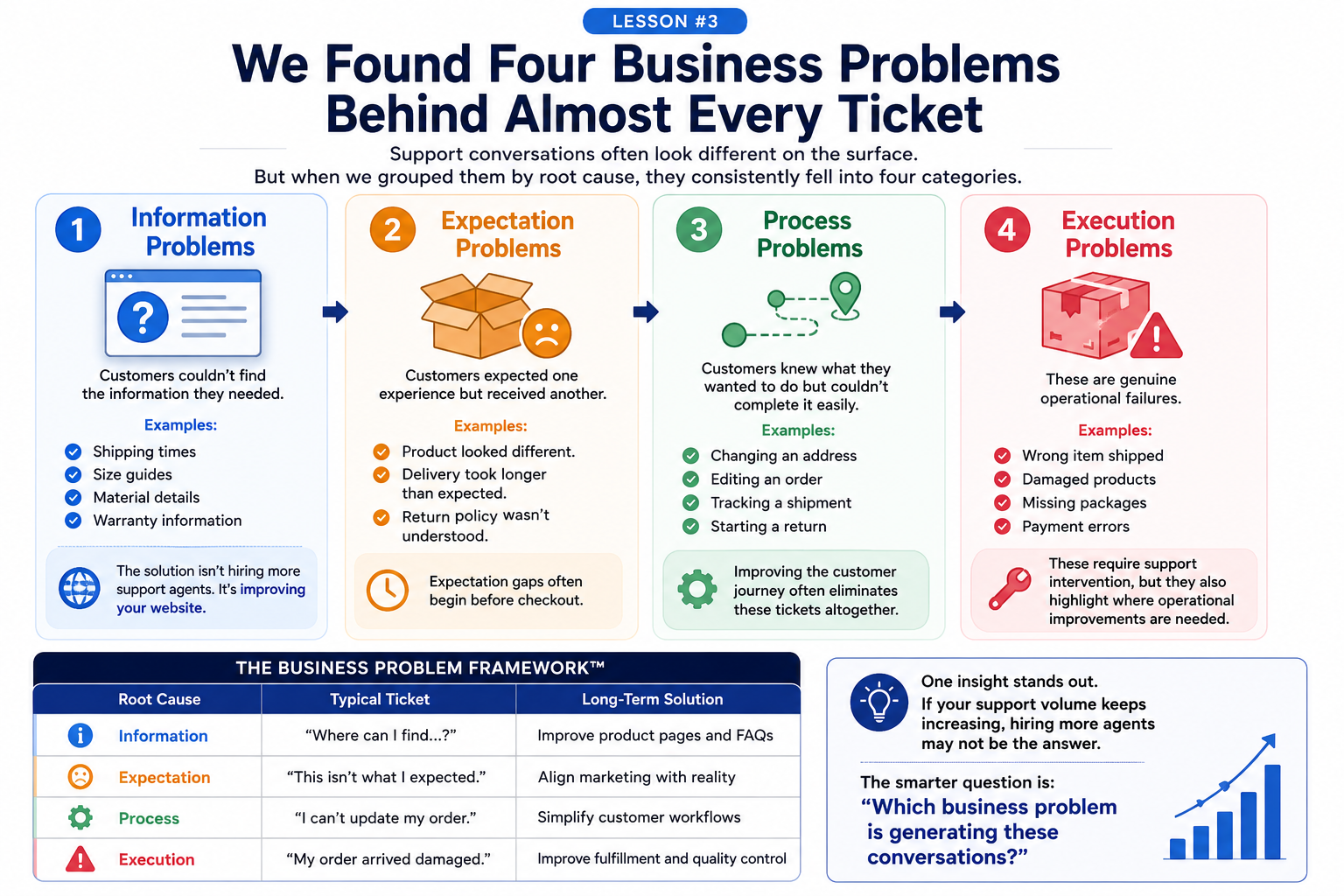
Support conversations often look different on the surface.
But when we grouped them by root cause, they consistently fell into four categories.
1. Information Problems
Customers couldn't find the information they needed.
Examples:
- Shipping times
- Size guides
- Material details
- Warranty information
The solution isn't hiring more support agents.
It's improving your website.
2. Expectation Problems
Customers expected one experience but received another.
Examples:
- Product looked different.
- Delivery took longer than expected.
- Return policy wasn't understood.
Expectation gaps often begin before checkout.
3. Process Problems
Customers knew what they wanted to do but couldn't complete it easily.
Examples include:
- Changing an address
- Editing an order
- Tracking a shipment
- Starting a return
Improving the customer journey often eliminates these tickets altogether.
4. Execution Problems
These are genuine operational failures.
For example:
- Wrong item shipped
- Damaged products
- Missing packages
- Payment errors
These require support intervention, but they also highlight where operational improvements are needed.
The Business Problem Framework™
| Root Cause | Typical Ticket | Long-Term Solution |
|---|---|---|
| Information | “Where can I find…?” | Improve product pages and FAQs |
| Expectation | “This isn't what I expected.” | Align marketing with reality |
| Process | “I can't update my order.” | Simplify customer workflows |
| Execution | “My order arrived damaged.” | Improve fulfillment and quality control |
One insight stands out.
If your support volume keeps increasing, hiring more agents may not be the answer.
The smarter question is:
“Which business problem is generating these conversations?”
Lesson #4: Some Tickets Should Never Exist
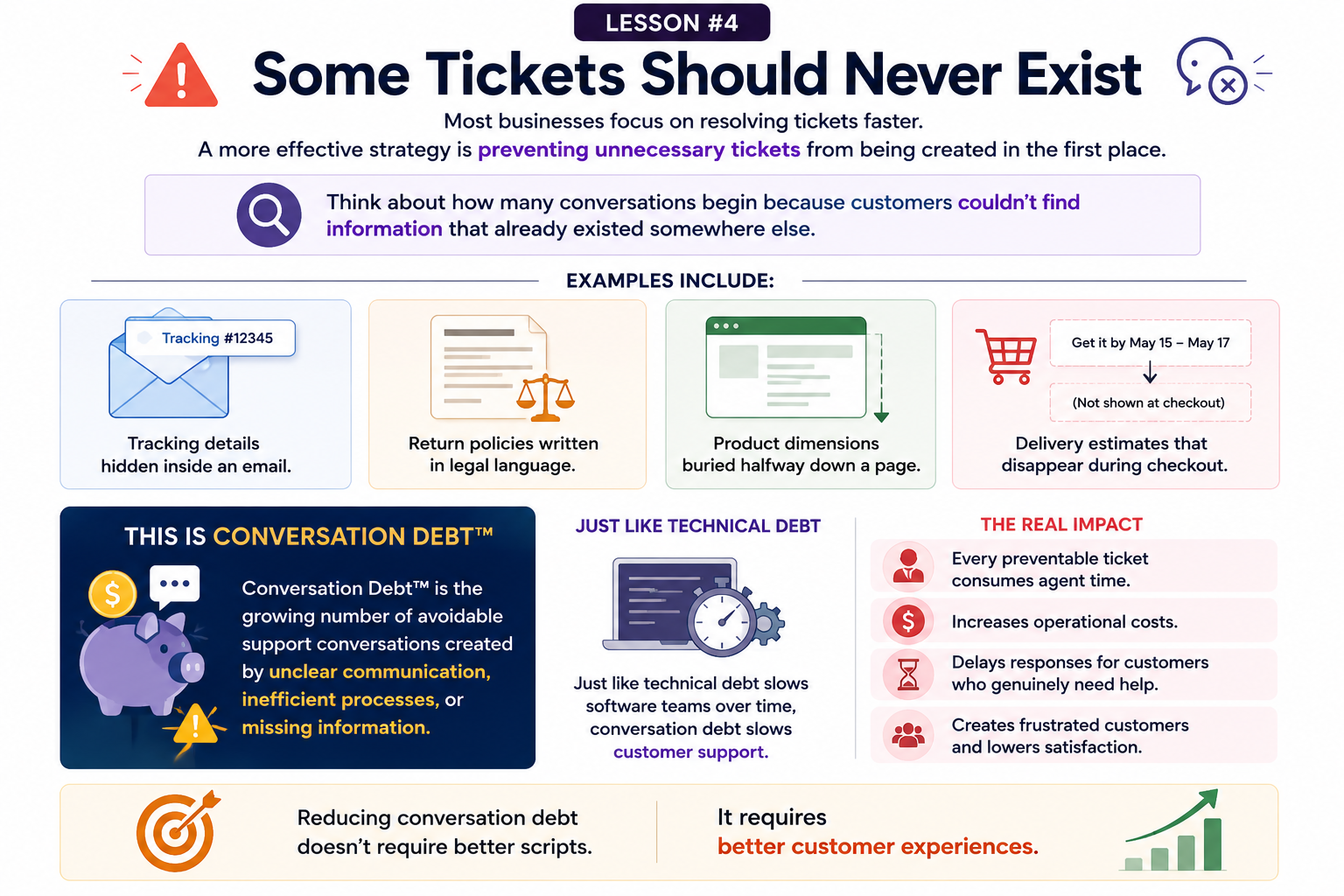
Most businesses focus on resolving tickets faster.
A more effective strategy is preventing unnecessary tickets from being created in the first place.
Think about how many conversations begin because customers couldn't find information that already existed somewhere else.
Examples include:
- Tracking details hidden inside an email.
- Return policies written in legal language.
- Product dimensions buried halfway down a page.
- Delivery estimates that disappear during checkout.
These are examples of what we call Conversation Debt™.
Conversation Debt™ is the growing number of avoidable support conversations created by unclear communication, inefficient processes, or missing information.
Just like technical debt slows software teams over time, conversation debt slows customer support.
Every preventable ticket consumes agent time, increases operational costs, and delays responses for customers who genuinely need help.
Reducing conversation debt doesn't require better scripts.
It requires better customer experiences.
Lesson #5: The Most Expensive Ticket Isn't the Hardest One
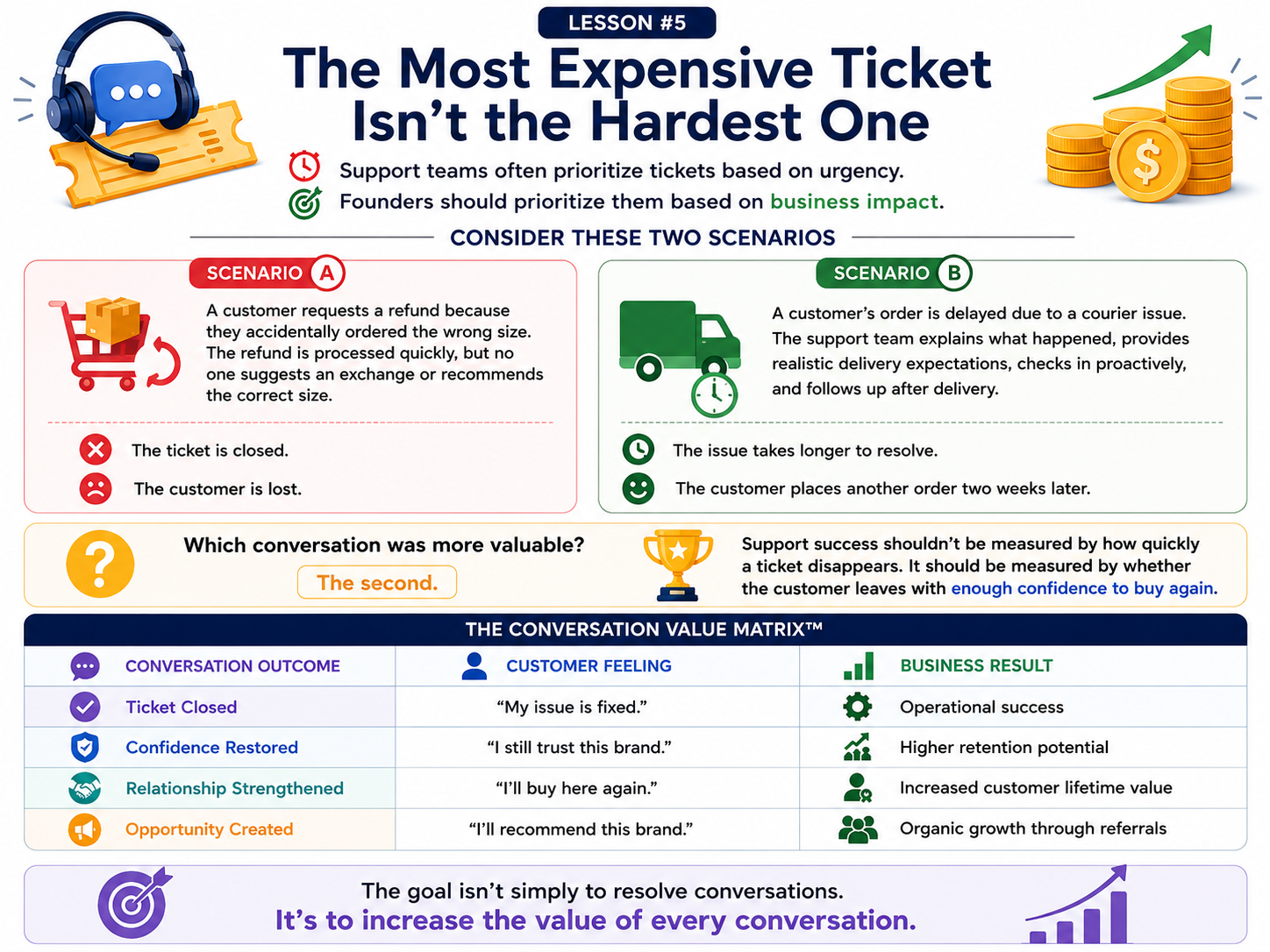
Support teams often prioritize tickets based on urgency.
Founders should prioritize them based on business impact.
Consider these two scenarios.
Scenario A
A customer requests a refund because they accidentally ordered the wrong size. The refund is processed quickly, but no one suggests an exchange or recommends the correct size.
The ticket is closed.
The customer is lost.
Scenario B
A customer's order is delayed due to a courier issue. The support team explains what happened, provides realistic delivery expectations, checks in proactively, and follows up after delivery.
The issue takes longer to resolve.
The customer places another order two weeks later.
Which conversation was more valuable?
The second.
Support success shouldn't be measured by how quickly a ticket disappears. It should be measured by whether the customer leaves with enough confidence to buy again.
The Conversation Value Matrix™
| Conversation Outcome | Customer Feeling | Business Result |
|---|---|---|
| Ticket Closed | “My issue is fixed.” | Operational success |
| Confidence Restored | “I still trust this brand.” | Higher retention potential |
| Relationship Strengthened | “I'll buy here again.” | Increased customer lifetime value |
| Opportunity Created | “I'll recommend this brand.” | Organic growth through referrals |
The goal isn't simply to resolve conversations.
It's to increase the value of every conversation.
Lesson #6: Great Support Answers the Next Question Before It's Asked
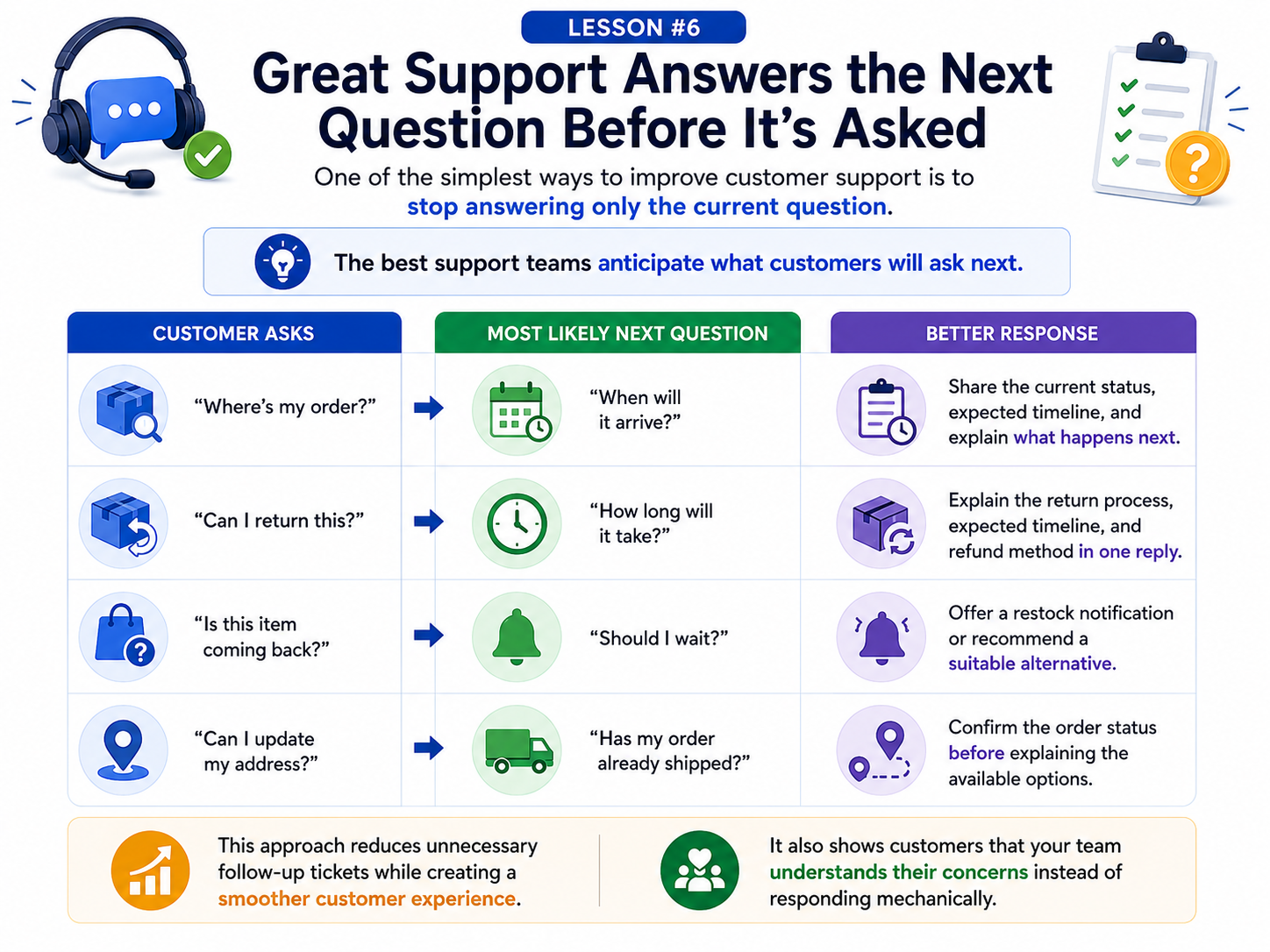
One of the simplest ways to improve customer support is to stop answering only the current question.
The best support teams anticipate what customers will ask next.
For example:
| Customer Asks | Most Likely Next Question | Better Response |
|---|---|---|
| “Where's my order?” | “When will it arrive?” | Share the current status, expected timeline, and explain what happens next. |
| “Can I return this?” | “How long will it take?” | Explain the return process, expected timeline, and refund method in one reply. |
| “Is this item coming back?” | “Should I wait?” | Offer a restock notification or recommend a suitable alternative. |
| “Can I update my address?” | “Has my order already shipped?” | Confirm the order status before explaining the available options. |
This approach reduces unnecessary follow-up tickets while creating a smoother customer experience.
It also shows customers that your team understands their concerns instead of responding mechanically.
A 30-Minute Founder Audit You Can Run Every Month
You don't need thousands of support tickets to uncover meaningful insights.
Review just 20 to 30 recent conversations every month and ask these questions.
1. Which questions appeared repeatedly?
If the same question appears multiple times, your website or buying journey is likely missing important information.
2. Which tickets could have been prevented?
Could clearer product descriptions, better shipping updates, or stronger FAQs have eliminated the conversation entirely?
3. Which conversations represented buying intent?
Look for customers asking about:
- Restocks
- Product comparisons
- Bulk purchases
- Shipping options
- Alternative products
These aren't just support requests.
They're sales opportunities.
4. Which replies sounded robotic?
Read them as if you were the customer.
Would you feel reassured?
Or would you immediately send another message?
5. Which departments should see these conversations?
Support shouldn't be the only team learning from customer feedback.
Marketing, operations, product, logistics, and ecommerce managers can all benefit from recurring customer insights.
The more departments learn from support conversations, the fewer preventable tickets you'll receive in the future.
Before & After: Small Changes That Build Customer Confidence
The difference between average and exceptional support often comes down to how information is communicated.
Example 1: Delivery Delay
Before
“Your shipment is delayed.”
After
“Your shipment has been delayed by the courier due to a routing issue. We've confirmed it's still in transit and are monitoring the shipment. If the estimated delivery date changes, we'll let you know before you need to ask.”
Example 2: Return Request
Before
“Please read our return policy.”
After
“You can return the product within our return window. Here's the quickest way to start the process, and if you have any questions along the way, we're here to help.”
Example 3: Out-of-Stock Product
Before
“Currently unavailable.”
After
“This product is temporarily out of stock. We expect new inventory soon, and we can notify you as soon as it's available. If you're looking for something similar today, we'd be happy to recommend an alternative.”
Notice what changed.
The responses didn't become dramatically longer.
They became more reassuring.
What Founders Should Measure Beyond Support Metrics
Traditional dashboards are useful.
But they rarely answer strategic questions.
Instead of reviewing only operational KPIs, consider adding these business-focused questions to your monthly review.
| Instead of Asking… | Ask This Instead |
|---|---|
| How many tickets did we close? | Which business process created those tickets? |
| How fast did we respond? | Did customers leave with greater confidence? |
| Which agent handled the most tickets? | Which conversations revealed opportunities to improve the business? |
| How many returns did we process? | Why did customers feel the need to return products? |
These conversations often highlight issues that analytics tools alone can't reveal.
Support teams hear customer frustrations in real time.
That's valuable business intelligence.
Frequently Asked Questions
Why should ecommerce businesses review customer support conversations?
Support conversations reveal recurring customer concerns, communication gaps, and operational issues that may not be visible in analytics dashboards. Reviewing them regularly helps improve both the customer experience and internal business processes.
How many support conversations should a business audit?
Even reviewing 20–30 conversations each month can reveal meaningful patterns. The goal isn't to analyze every ticket but to identify recurring themes and opportunities for improvement.
What's the biggest mistake businesses make with customer support?
Many businesses focus only on resolving tickets instead of understanding why customers contacted support in the first place. Addressing the root cause often prevents future conversations and reduces support costs.
Can support conversations improve ecommerce sales?
Yes. Questions about restocks, shipping, product comparisons, or bulk orders often indicate strong purchase intent. Recognizing these conversations as opportunities—not interruptions—can directly contribute to revenue growth.
How can businesses reduce repetitive support tickets?
Improve product information, simplify the buying journey, provide proactive shipping updates, and regularly review recurring customer questions. Preventing unnecessary conversations is often more effective than answering them faster.
What is Conversation Debt™?
Conversation Debt™ refers to avoidable support tickets caused by unclear communication, inefficient processes, or missing information. Reducing Conversation Debt improves operational efficiency while creating a better customer experience.
Should founders read support conversations themselves?
Yes. Reviewing a sample of conversations every month helps founders understand customer concerns directly instead of relying only on dashboards and reports. It often reveals business issues that traditional analytics miss.
When should an ecommerce business consider outsourcing customer support?
Businesses often explore outsourcing when maintaining consistent response quality becomes difficult because of rapid growth, seasonal demand, or the need for extended support hours. The right outsourcing partner shouldn't just answer tickets—they should provide insights that help improve the entire customer experience.
Conclusion
When we stepped back and reviewed recurring ecommerce support conversations, one insight stood out above everything else:
Support conversations are rarely just about support.
They're windows into your customer's decision-making process.
Every question about shipping, returns, product details, or order updates tells a story about where confidence was lost—and where your business has an opportunity to improve.
That's why the most successful ecommerce brands don't see support as a department that fixes problems after they happen.
They see it as a continuous feedback loop that improves marketing, product pages, operations, fulfillment, and customer experience.
If your team only measures response times, you'll know how efficiently you're handling tickets.
If you regularly analyze why those tickets exist, you'll discover opportunities to reduce friction, strengthen customer trust, and increase long-term loyalty.
At AAA Outsourcing, that's how we think about ecommerce customer support. Not as a standalone service, but as a strategic business function that helps ecommerce brands understand their customers better, improve their operations, and create experiences that encourage people to return—not because they have another problem, but because they genuinely trust the brand.
 ✔
✔